
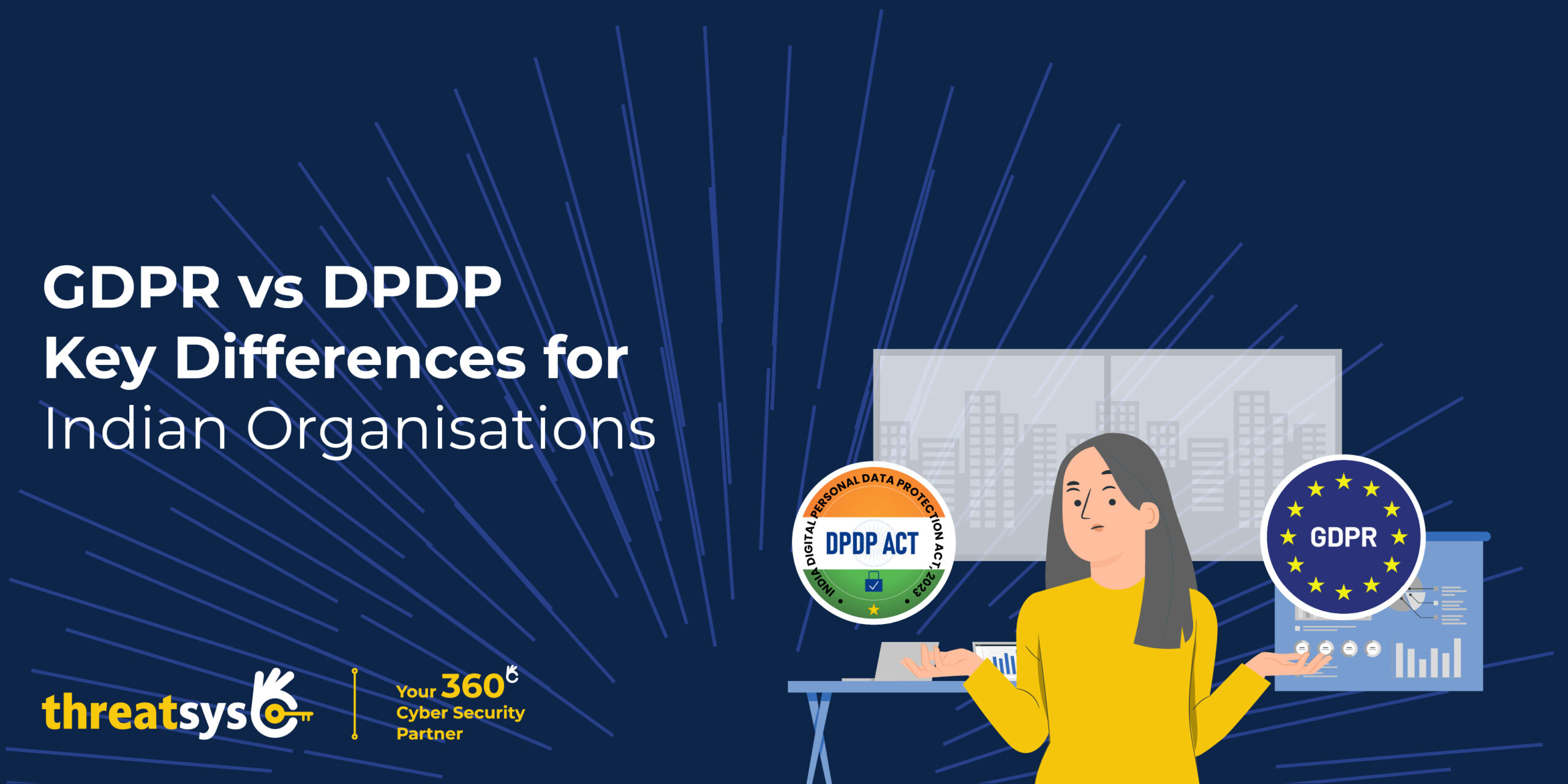

As data becomes central to business operations, Indian organizations increasingly operate across global data ecosystems. Handling both Indian and EU personal data makes it essential to understand the differences between GDPR and India’s DPDP Act, 2023. While both laws aim to protect personal data, they differ in scope, compliance requirements, and enforcement ,making clarity critical to avoid penalties and operational risk.
This blog highlights the key differences between GDPR and DPDP in a clear, business-focused manner.
Understanding GDPR and DPDP
What is GDPR?
The General Data Protection Regulation (GDPR) is the European Union’s data protection law, effective from 2018. It governs how organizations collect, process, and protect personal data of EU residents. GDPR applies globally, meaning Indian companies may fall under its scope if they handle EU personal data.
What is DPDP Act?
The Digital Personal Data Protection (DPDP) Act, 2023 is India’s primary data protection law. It regulates the processing of digital personal data of individuals in India and defines obligations for organizations, known as Data Fiduciaries.
In 2025, updated implementation guidelines strengthened areas such as consent management, breach reporting, cross-border data transfers, and vendor governance, making DPDP more structured and aligned with global standards.
GDPR vs DPDP: Key Differences Explained
1. Applicability and Scope
GDPR has a broad extraterritorial scope and applies to organizations worldwide that process EU personal data.
DPDP focuses primarily on India but also applies to foreign entities processing Indian citizens’ data.
2. Legal Basis and Consent
GDPR allows multiple lawful bases for processing, including consent, contracts, and legitimate interests.
DPDP follows a consent-first model, with limited exceptions.
3. Individual Rights
GDPR grants extensive rights such as data portability, restriction, and objection.
DPDP provides a simpler set of rights focused on access, correction, erasure, and grievance redressal.
4. Accountability Framework
GDPR applies uniform accountability obligations across organizations.
DPDP introduces Significant Data Fiduciaries (SDFs) with additional compliance requirements.
5. Data Protection Officer (DPO)
GDPR mandates DPOs for high-risk data processing activities.
DPDP requires DPOs only for Significant Data Fiduciaries.
6. Cross-Border Data Transfers
GDPR mandates approved transfer mechanisms such as SCCs and adequacy decisions. DPDP allows transfers unless restricted by the Indian Government.
7. Data Breach Notification
GDPR requires breach reporting within 72 hours and user notification in high-risk cases.
DPDP focuses on notifying government authorities as per prescribed timelines.
8. Penalties
GDPR penalties can reach €20 million or 4% of global turnover.
DPDP penalties can go up to ₹250 crore per violation.
How Threatsys Helps with GDPR and DPDP Compliance

Threatsys delivers a structured, end-to-end approach to help organizations achieve GDPR and DPDP compliance with minimal operational impact.
1. GDPR & DPDP Gap Assessment
We assess your current data practices, policies, and controls to identify compliance gaps against GDPR and DPDP requirements.
2. Data Mapping & Risk Identification
Threatsys maps personal data flows across systems and vendors to ensure visibility, accountability, and risk identification.
3. Consent & Privacy Framework Alignment
We align consent mechanisms, privacy notices, and withdrawal processes with GDPR lawful bases and DPDP’s consent-driven model.
4. Documentation & Policy Development
Threatsys drafts and updates audit-ready policies, SOPs, and privacy documentation required under both regulations.
5. Security & Technical Control Implementation
We implement essential security controls such as encryption, access management, MFA, and monitoring to protect personal data.
6. Vendor & Third-Party Compliance
Threatsys reviews vendors, updates DPAs, and strengthens third-party governance to reduce compliance risks.
7. Data Subject & Data Principal Rights Management
We help set up efficient workflows to handle data access, correction, erasure, and grievance requests within timelines.
8. Audit Readiness & Ongoing Support
Threatsys supports DPIAs, compliance reviews, and ongoing advisory to keep your organization audit-ready.
What This Means for Indian Organizations
Indian businesses must determine whether they fall under DPDP only or both DPDP and GDPR. Organizations operating globally ,especially in BFSI, healthcare, SaaS, IT services, and e-commerce ,must align consent, vendor governance, breach response, and accountability frameworks to meet both regulations.
Conclusion
While GDPR and DPDP share the common goal of protecting personal data, their compliance frameworks differ in scope, flexibility, and enforcement. GDPR is globally mature and highly stringent, while DPDP reflects India’s evolving digital governance model.
For Indian organizations, understanding these differences is not just about regulatory compliance ,it is about reducing risk, strengthening trust, and building a future-ready data protection strategy. With expert guidance from Threatsys , businesses can navigate both GDPR and DPDP requirements confidently through structured assessments, strong security controls, and audit-ready compliance frameworks.

Stay secure, stay aware with Threatsys.