

As organizations adopt cloud services, remote work models, and interconnected applications, internal environments have become a prime target for attackers. Traditional perimeter-based security assumes internal users and systems are trustworthy, which allows attackers to move laterally once access is gained.
Zero Trust Architecture (ZTA) removes this implicit trust by enforcing strict identity verification, least-privilege access, and controlled communication between systems. This approach significantly reduces internal attack surfaces and limits the impact of security breaches.
This blog explains how Zero Trust Architecture works and how it minimizes internal threats across modern IT environments.
Understanding Zero Trust Architecture
Zero Trust is a security model based on the principle of “never trust, always verify.” Every access request is continuously validated, regardless of whether it originates from inside or outside the network.
Instead of relying on network location, Zero Trust focuses on identity, device posture, and contextual risk before granting access. Trust is never assumed and is continuously reassessed throughout the session.

What Are Internal Attack Surfaces?
Internal attack surfaces refer to the systems, identities, and access paths that attackers exploit after gaining initial entry. These typically arise due to:
- Excessive user and service permissions
- Flat or poorly segmented internal networks
- Weak identity and access controls
Once inside the environment, attackers often move laterally to escalate privileges and access critical systems. Zero Trust is specifically designed to prevent this type of internal spread.
How Zero Trust Minimizes Internal Attack Surfaces
Strong Identity-Centric Access Control
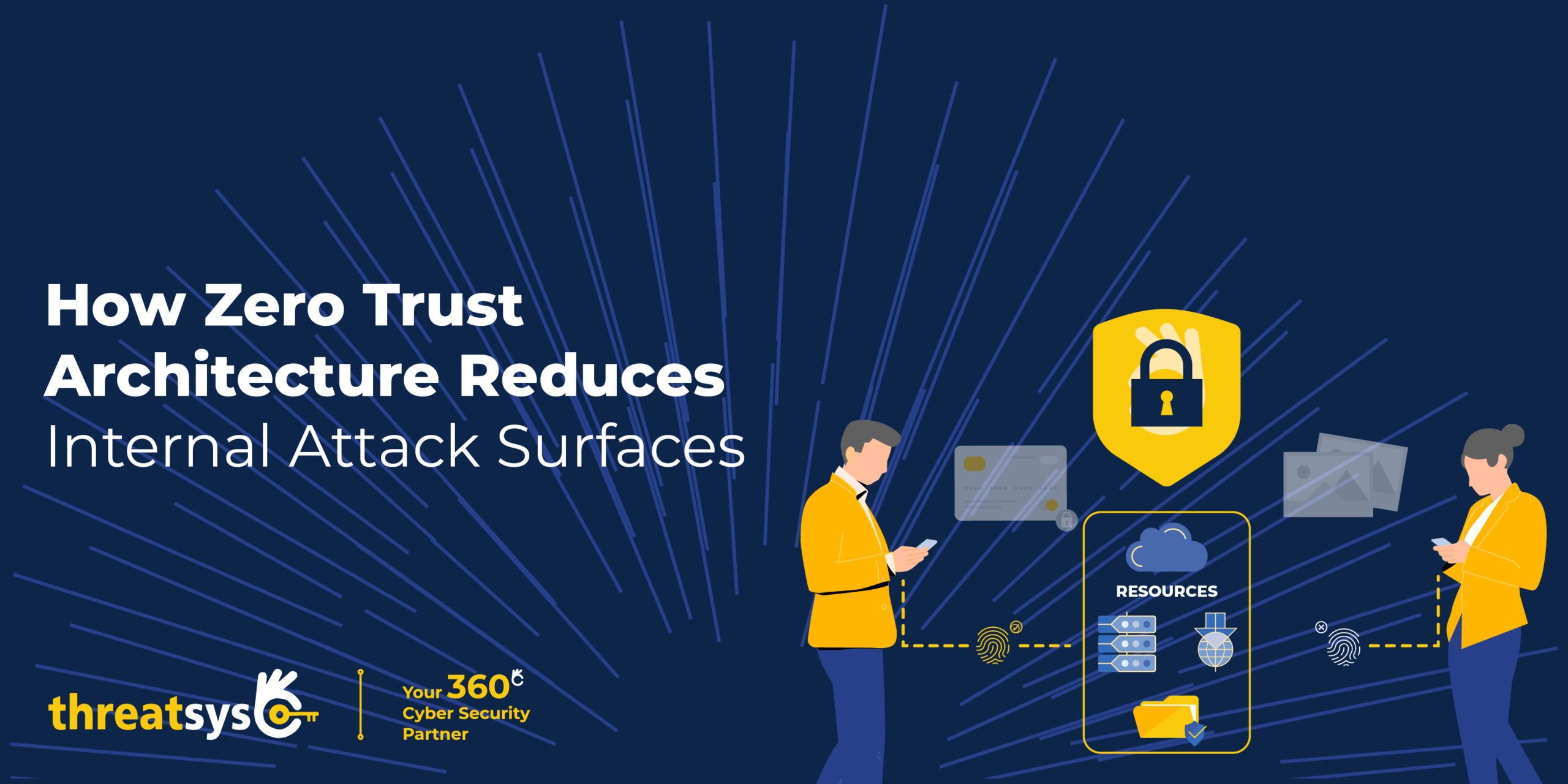
Zero Trust ensures that every user and system is authenticated and authorized for each request. Access decisions are based on identity, behavior, and real-time risk context rather than simple login success.
This significantly reduces the effectiveness of stolen credentials and limits unauthorized access within internal environments.
Least Privilege Access
Access is granted only to what is strictly required for a specific task and for a limited duration. By eliminating unnecessary permissions, Zero Trust:
- Reduces the blast radius of compromised accounts
- Prevents privilege escalation
- Limits the impact of insider threats
Even if an attacker gains access, their ability to move or cause damage is heavily restricted.
Controlled Internal Network Communication
Zero Trust replaces flat internal networks with tightly controlled communication paths. Systems and applications can only interact when explicitly permitted.
This limits lateral movement and prevents attackers from freely navigating internal environments.
Continuous Monitoring and Validation
Zero Trust continuously evaluates user behavior, device health, and access patterns. Any suspicious activity can trigger re-authentication or immediate access revocation.
This enables early detection of compromised accounts and significantly reduces attacker dwell time.

Zero Trust in Cloud and Hybrid Environments
Cloud and hybrid environments introduce dynamic workloads, APIs, and identity-driven access models, increasing internal exposure. Zero Trust aligns naturally with cloud security by enforcing:
- Identity-based access controls
- Application-level security enforcement
- Continuous visibility across workloads
This makes Zero Trust particularly effective in hybrid and multi-cloud architectures.
Common Challenges in Zero Trust Adoption
Organizations may face challenges when implementing Zero Trust, including:
- Treating Zero Trust as a single product rather than a long-term strategy
- Limited visibility into internal access relationships
- Overly complex or restrictive access policies
A phased, risk-based implementation approach helps organizations address these challenges effectively.
How Threatsys Supports Zero Trust Implementation

Threatsys helps organizations adopt Zero Trust through a structured, risk-driven, and business-aligned approach. Rather than focusing only on deploying security tools, we concentrate on identifying and reducing real internal attack surfaces that expose organizations to risk.
Our Zero Trust support includes:
- Identifying risky internal access paths, over-privileged accounts, and hidden lateral movement opportunities
- Designing and enforcing least-privilege access models across users, devices, applications, and service identities
- Strengthening identity security, access governance, and internal segmentation to limit unauthorized movement
- Validating Zero Trust controls through targeted security testing to ensure policies work as intended in real-world scenarios
Threatsys ensures that Zero Trust implementation enhances security without impacting operational efficiency, enabling organizations to achieve measurable risk reduction while supporting long-term business goals.
Conclusion
Partnering with experienced security specialists like Threatsys ensures that Zero Trust adoption delivers long-term, measurable security outcomes aligned with business priorities. Through a structured, risk-based approach, organizations can implement Zero Trust without disrupting operations while effectively reducing real internal attack surfaces.
Internal attack surfaces remain one of the most significant risks in modern IT environments. Zero Trust Architecture addresses this challenge by eliminating implicit trust, enforcing least privilege, and restricting lateral movement—significantly reducing internal threats and strengthening overall security posture.

Stay secure, stay aware with Threatsys.