

Global SOC Platforms Cost ₹5 Crore+ Annually and Are Built for Western Infrastructure. CYQER Is Built for India, Here Is the Honest Comparison Every Indian CISO Needs.
A complete guide to SOC platform selection for Indian enterprises in 2026 comparing CYQER, Splunk, IBM QRadar, and Microsoft Sentinel on cost, deployment, AI automation, and compliance.
You’ve deployed firewalls. You’ve hired SOC analysts. You’ve signed off on a SIEM budget that grows every renewal cycle. And you still don’t actually know if the platform you’re paying for was ever built for your enterprise or for someone else’s.
This is the reality Indian CISOs are waking up to in 2026. SOC platforms that were designed around Fortune 500 budgets, US and European infrastructure, and large in-house security engineering teams are being deployed at Indian banks, hospitals, factories, and government agencies that operate under none of those assumptions. And the bills reflect it.
SOC platform selection in 2026 is not a checkbox exercise. The costs are real, the vendor lock-in is real, and the mismatch between platform design and Indian enterprise reality is already showing up in renewal negotiations across the country.
What Should a Modern SOC Platform Actually Do?
A SOC platform is meant to give a security team centralized visibility and control not just log collection, but real-time detection, automated response, threat intelligence, asset visibility, behavioural analytics, and compliance reporting, all built to scale with the organization’s actual size and budget.
That capability is the value. It’s also exactly where the pricing model breaks down for most Indian budgets because the platforms delivering it were priced for a very different kind of buyer.
In 2026, Indian enterprises are running SOC platforms across:
- Banking and fintech fraud detection, transaction monitoring, KYC compliance
- Healthcare patient data protection, DPDP compliance, ransomware defense
- IT, operations, and manufacturing infrastructure monitoring, supply chain security
- Government digital services citizen data protection, CERT-In mandated audits
Each of these deployments runs on a platform with privileged visibility into the entire IT estate. That visibility is only as valuable as what it actually costs the organization to sustain it year over year.
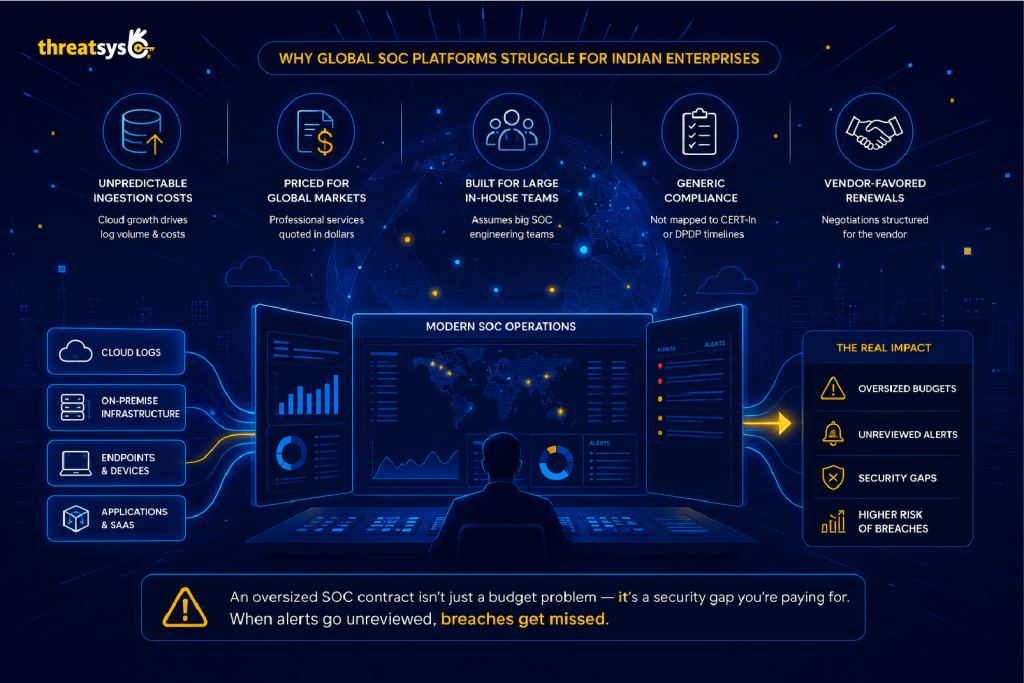
Why Global SOC Platforms Struggle for Indian Enterprises
Traditional enterprise software has predictable, fixed licensing. Ingestion-based SIEM pricing does not it’s dynamic, shaped directly by how much data an organization logs, and that volume only grows as cloud adoption accelerates. That makes long-term cost planning fundamentally harder for Indian IT and finance teams.
The pricing mismatch is the core of it. A platform priced and packaged for a large Western enterprise assumes budgets, engineering headcount, and infrastructure maturity that most Indian organizations simply don’t have and every one of those assumptions shows up as a line item on the invoice.
- Ingestion-based pricing scales unpredictably as cloud adoption accelerates
- Professional services are quoted in dollars, not rupees
- Global platforms assume large in-house SOC engineering teams most Indian enterprises don’t have
- Compliance reporting is generic, not mapped to CERT-In or DPDP timelines
- Renewal negotiations are structured to favor the vendor, not the customer
An oversized SOC contract isn’t just a budget problem it’s a security gap you’re paying for the privilege of. When a CISO can’t justify further tuning or scaling of an expensive platform, alerts go unreviewed. And unreviewed alerts are how breaches get missed at 3 a.m.
Real 2026 Data Point: The Ingestion Cost Spiral
Microsoft has reported that events processed by Sentinel surged roughly 150% year-over-year during 2025 driven simply by enterprises logging more as they moved deeper into the cloud. No breach, no bad actor just normal growth colliding with ingestion-based pricing.
What makes this pattern instructive for Indian buyers:
- Ingestion volume grew organically as enterprises adopted more cloud services there was no single triggering incident
- Organizations without tiered hot/warm/cold retention policies saw storage costs scale linearly with data volume, not with actual security need
- Ingestion-based pricing rewards logging everything and then punishes the organization with the resulting bill
- Most enterprises had no cost-governance layer in place to flag spend crossing budget thresholds before the renewal invoice arrived
This is the template for SOC platform cost overruns in 2026. It isn’t a one-off event it’s the default trajectory of any ingestion-based pricing model left unmanaged.
Top 5 Reasons SOC Costs Spiral for Indian Enterprises
| Cost Driver | Root Cause | Impact on Indian Enterprises |
| Ingestion-Based Pricing | Log volume grows with cloud and data adoption | Bills scale even when actual threat volume stays flat |
| Professional Services | Complex deployment needs vendor-certified consultants | Multi-lakh to multi-crore implementation fees |
| Tool Sprawl | SIEM, SOAR, UEBA, and vuln management bought as separate products | Redundant licensing and disconnected dashboards |
| Talent Dependency | Platform requires specialized, certified engineers | Hiring and retention costs stack on top of licensing |
| Generic Compliance Mapping | Reports not pre-aligned to CERT-In or DPDP | Manual compliance translation work every audit cycle |
Cost Structure Explained
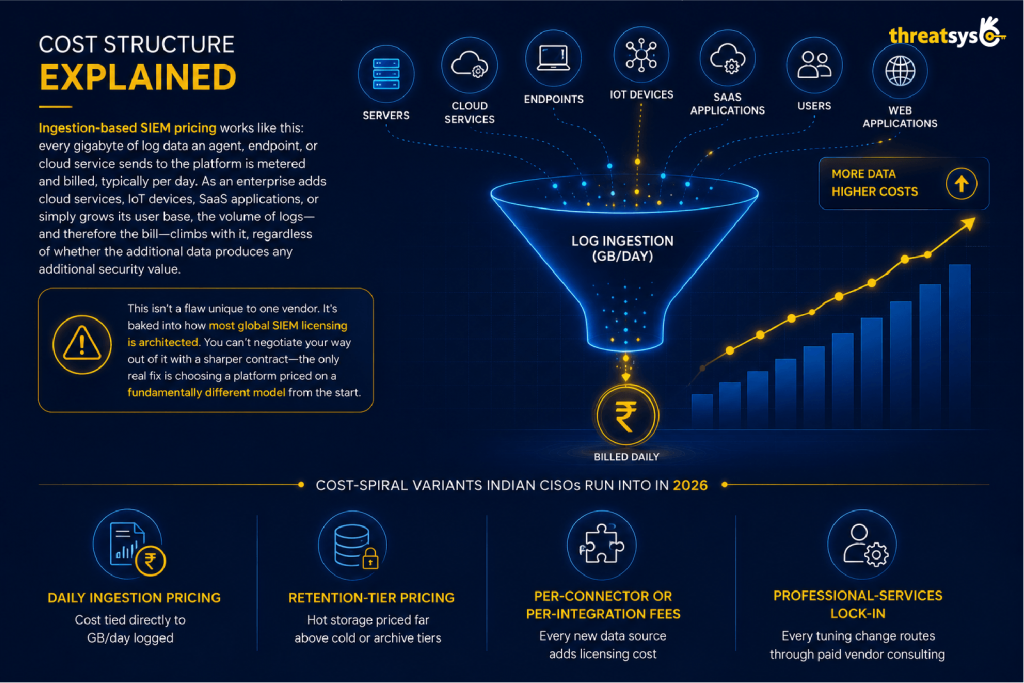
Ingestion-based SIEM pricing works like this: every gigabyte of log data an agent, endpoint, or cloud service sends to the platform is metered and billed, typically per day. As an enterprise adds cloud services, IoT devices, SaaS applications, or simply grows its user base, the volume of logs and therefore the bill climbs with it, regardless of whether the additional data produces any additional security value.
This isn’t a flaw unique to one vendor. It’s baked into how most global SIEM licensing is architected. You can’t negotiate your way out of it with a sharper contract the only real fix is choosing a platform priced on a fundamentally different model from the start.
Cost-spiral variants Indian CISOs run into in 2026:
- Daily ingestion pricing cost tied directly to GB/day logged
- Retention-tier pricing hot storage priced far above cold or archive tiers
- Per-connector or per-integration fees every new data source adds licensing cost
- Professional-services lock-in every tuning change routes through paid vendor consulting
Compliance Identity for Indian Enterprises
Every Indian enterprise now operates under a stack of overlapping local regulations. A SOC platform should be able to demonstrate compliance readiness at any moment not just surface generic dashboards that someone still has to translate manually.
- CERT-In’s six-hour incident reporting requirement built into the workflow, not treated as an afterthought
- DPDP Act data-fiduciary obligations mapped directly onto compliance dashboards
- RBI and SEBI sector-specific frameworks pre-configured rather than custom-built per client
- Audit trails formatted for Indian regulators, not generic global templates
- 180-day log retention aligned to DPDP Act expectations by default
Without this kind of mapping, compliance teams spend every audit season manually translating generic SIEM reports into CERT-In and DPDP language a recurring cost that never shows up on the licensing invoice, but shows up in headcount and hours all the same.
Cost Discipline: What Indian Enterprises Should Demand
The principle is simple: pay for the ingestion, coverage, and modules an organization actually needs nothing padded for worst-case projections that may never materialize. For Indian enterprises operating on tighter security budgets than their global counterparts, this discipline matters more, not less.
- Scope licensing to actual log volume needs, not worst-case projections
- Avoid multi-year ingestion commitments locked in before usage patterns are known
- Use tiered retention hot, warm, cold to keep storage costs under control
- Negotiate predictable, bundled pricing instead of pure ingestion-based models
- Regularly audit which modules and connectors are actually being used, and cut what isn’t
Cost discipline doesn’t reduce the value of enterprise-grade SOC capability it just stops the invoice from growing faster than the actual threat landscape does.
How to Evaluate a SOC Platform
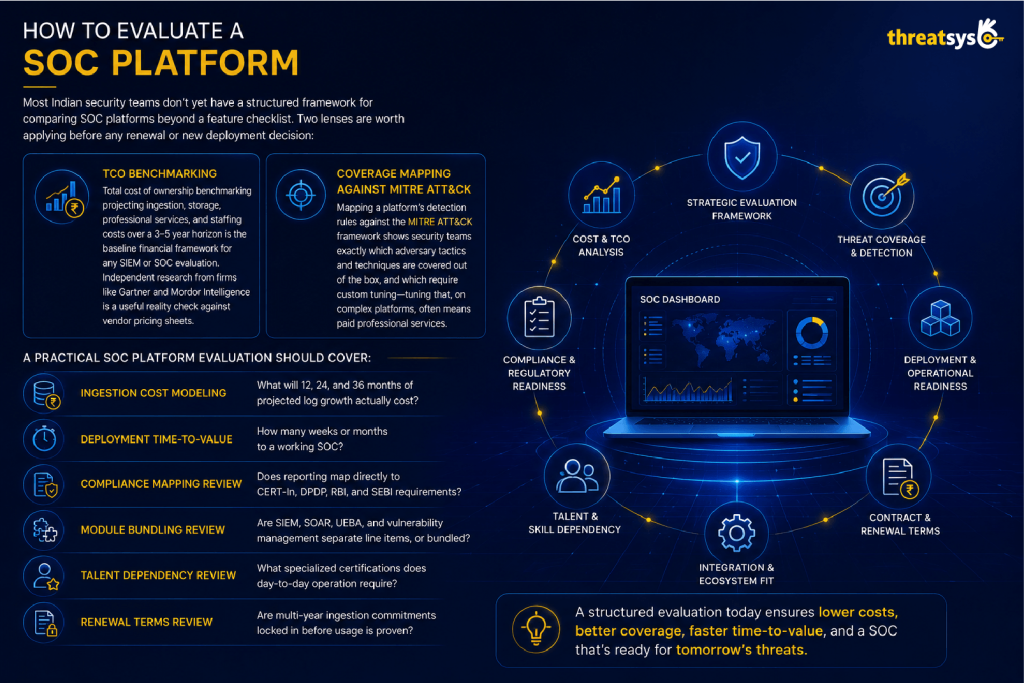
Most Indian security teams don’t yet have a structured framework for comparing SOC platforms beyond a feature checklist. Two lenses are worth applying before any renewal or new deployment decision:
TCO Benchmarking
Total cost of ownership benchmarking projecting ingestion, storage, professional services, and staffing costs over a 3-5 year horizon is the baseline financial framework for any SIEM or SOC evaluation. Independent research from firms like Gartner and Mordor Intelligence is a useful reality check against vendor pricing sheets.
Coverage Mapping Against MITRE ATT&CK
Mapping a platform’s detection rules against the MITRE ATT&CK framework shows security teams exactly which adversary tactics and techniques are covered out of the box, and which require custom tuning tuning that, on complex platforms, often means paid professional services.
A practical SOC platform evaluation should cover:
- Ingestion cost modeling what will 12, 24, and 36 months of projected log growth actually cost?
- Deployment time-to-value how many weeks or months to a working SOC?
- Compliance mapping review does reporting map directly to CERT-In, DPDP, RBI, and SEBI requirements?
- Module bundling review are SIEM, SOAR, UEBA, and vulnerability management separate line items, or bundled?
- Talent dependency review what specialized certifications does day-to-day operation require?
- Renewal terms review are multi-year ingestion commitments locked in before usage is proven?
Feature-by-Feature Snapshot
| Feature | CYQER | Splunk | IBM QRadar | Microsoft Sentinel |
| SIEM | Yes | Yes | Yes | Yes |
| SOAR | Built-in | Add-on | Partial | Built-in |
| UEBA | Yes | Yes | Yes | Yes |
| AI-Powered Detection | Yes | Partial | Partial | Yes |
| Compliance Dashboards | Yes | Custom | Available | Available |
| Vulnerability Management | Yes | External Tool | External Tool | External Tool |
| Indian Compliance Focus | Yes | Limited | Limited | Limited |
Indian Enterprise Context
India’s enterprise adoption of security operations is accelerating faster than most organizations’ budgets were originally sized for and the risk profile is unique to the market.
Independent research pegs the global SIEM market at roughly USD 8-12 billion in 2026, growing at double-digit CAGR through 2031, with Asia-Pacific and India specifically repeatedly flagged as the fastest-growing region. India’s own cybersecurity market is estimated between USD 5.5 billion and USD 11.3 billion in 2025, and Gartner forecasts India’s end-user information security spending will reach USD 3.4 billion in 2026, up 11.7% year-over-year.
India-specific factors that amplify SOC cost and coverage risk:
- Rapid cloud adoption that outpaces budget planning cycles
- A persistent SOC talent shortage NASSCOM estimates a roughly 40% deficit in India’s cybersecurity workforce
- Heavy reliance on MSSPs and outsourcing for 24×7 coverage, adding another cost layer
- Regulatory pressure from DPDP and CERT-In without matching clarity from global platform vendors
- Multi-year contracts signed before actual usage patterns, and therefore true cost, are known
A ballooning SIEM bill at a large Indian BFSI institution or PSU doesn’t just strain the IT budget it forces a trade-off between platform capability and analyst headcount, at exactly the moment attackers are counting on under-resourced SOCs.
How CYQER Helps Indian Enterprises
Securing an Indian enterprise’s SOC operations calls for a platform priced and built around the market it actually serves not retrofitted from a Western product line. CYQER is designed around how Indian security teams actually operate, budget, and report.
Unified SIEM and SOAR
CYQER combines SIEM, SOAR, UEBA, threat intelligence, and asset discovery into a single platform, cutting the licensing overhead and dashboard-hopping that comes with stitching together separate tools.
Built-In Compliance Automation
CYQER’s compliance dashboards are mapped directly to CERT-In, DPDP, RBI, and SEBI requirements, reducing the manual translation work Indian compliance teams otherwise repeat every audit cycle.
Vulnerability and Asset Visibility
CYQER includes built-in vulnerability visibility and asset discovery, removing the need for a separate standalone vulnerability-management tool and the licensing that comes with it.
Predictable, India-Priced Licensing
CYQER is built around predictable pricing designed for Indian enterprise budgets, avoiding the unmanaged ingestion-cost spiral that drives up bills on legacy global platforms.
From detection to compliance to cost control CYQER covers the full SOC lifecycle, built around how Indian enterprises actually operate.
How Threatsys Technologies Supports SOC Platform Selection and Deployment

Choosing between CYQER, Splunk, IBM QRadar, and Microsoft Sentinel is an architectural decision (one that shapes everything built on top of it), not just a procurement one and most Indian enterprises lack a structured, vendor-neutral way to make that call.
Threatsys Technologies fills that gap, helping enterprises move past vendor pitch decks to actually evaluate, deploy, and run a SOC platform end-to-end:
- Readiness Assessment and Gap Analysis — Reviews the current security stack, log sources, and analyst capacity against what a modern SOC platform needs, so the CYQER-vs-Splunk-vs-QRadar-vs-Sentinel decision is driven by operational fit, not a feature checklist.
- Log Source and Data Discovery — Maps log-generating systems, volume, and criticality upfront, so ingestion costs can be modeled accurately before any contract is signed.
- Evaluation Framework and Governance — Builds weighted evaluation criteria (TCO, MITRE ATT&CK coverage, compliance alignment, deployment timelines) so the final choice holds up to audit rather than favoring whoever pitched hardest.
- Deployment Support — Handles configuration, integration, and tuning, cutting reliance on costly vendor professional-services engagements.
- Continuous Monitoring and Optimization — Tracks usage and cost against actual need, catching ingestion-cost spirals and coverage gaps early instead of at the next renewal.
Conclusion
The next SIEM renewal notice your finance team pushes back on likely won’t be about a security failure it’ll be about a pricing model built for a market your organization doesn’t operate in. SOC platform economics in 2026 is not a future concern. Indian enterprises are paying the difference right now, in licensing fees that outpace their actual threat landscape.
The organizations that choose platforms built for their real budget, compliance stack, and talent pool will be the ones that can sustain SOC operations for the long run. The ones that keep renewing global contracts by default will find out what “built for a different market” costs, the hard way.
To stay ahead, businesses must adopt proactive, intelligence-driven security strategies that simulate real-world threats and continuously validate their defenses. With Threatsys , organizations can build a resilient and future-ready security framework—ensuring their systems remain protected in an increasingly connected world.
Stay secure, stay aware with Threatsys.