

98% of Companies Have a Vendor That Was Hacked.
Your Next Breach Won’t Come Through Your Front Door : It’ll Come Through Your Supplier’s.
A complete guide to software supply chain security India 2026 for enterprises that understand the real attack surface isn’t just their own network.
You patched your systems. You trained your staff. You deployed MFA and endpoint protection. And then your payroll software vendor got breached and attackers walked straight into your environment through a trusted integration.
This is the reality of supply chain attacks in 2026. The perimeter you secured is not the perimeter being targeted. Attackers have figured out that the fastest route into a well-defended enterprise is through the software it trusts, the vendors it relies on, and the open-source libraries its developers pull in without a second thought.
Software supply chain security India 2026 is not a niche concern for large enterprises anymore. It is a frontline problem for any organization that uses third-party software, contracts with managed service providers, or runs a development team that pulls dependencies from the internet which is almost every company operating in India today.
What Is a Software Supply Chain Attack?
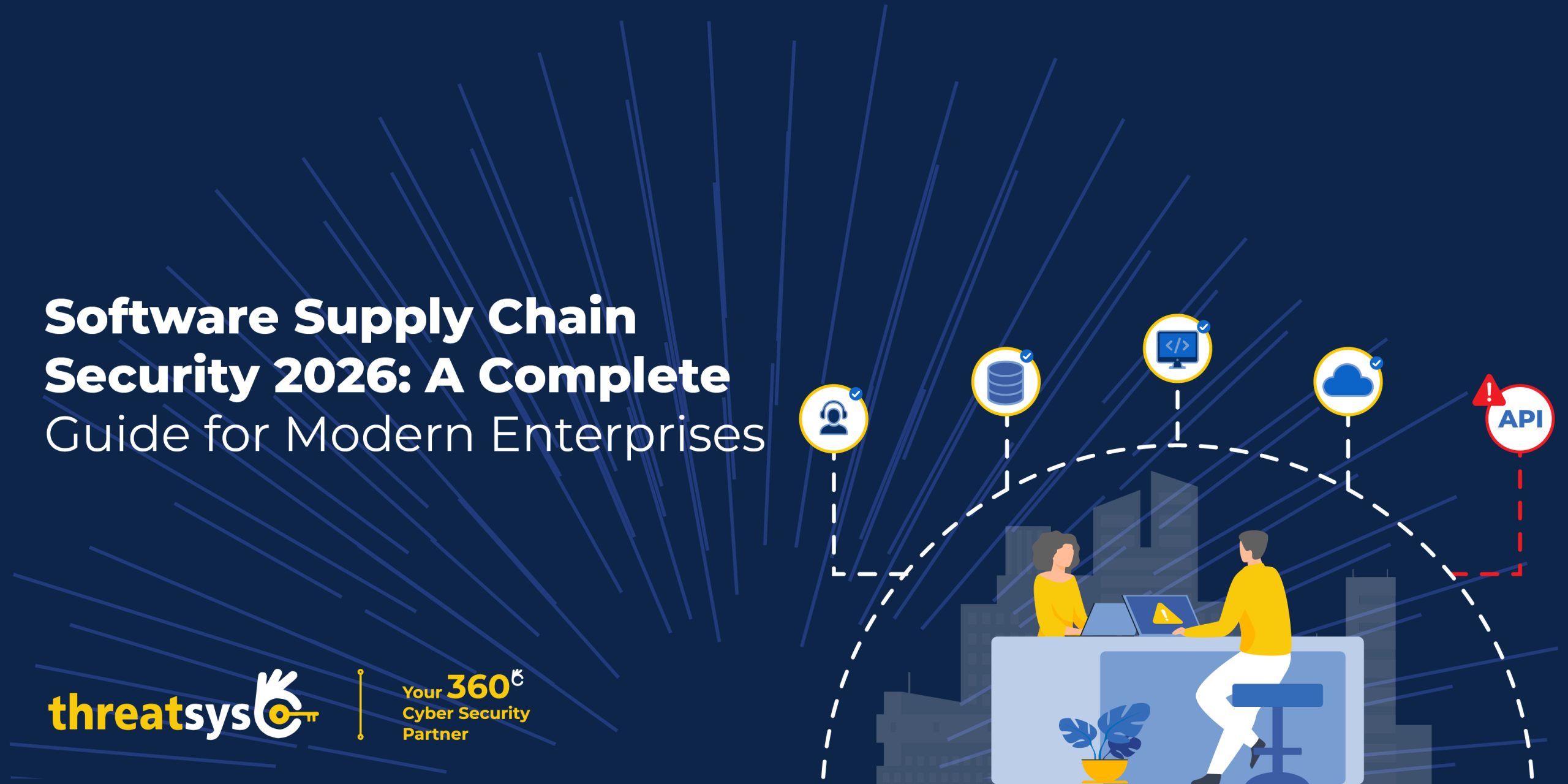
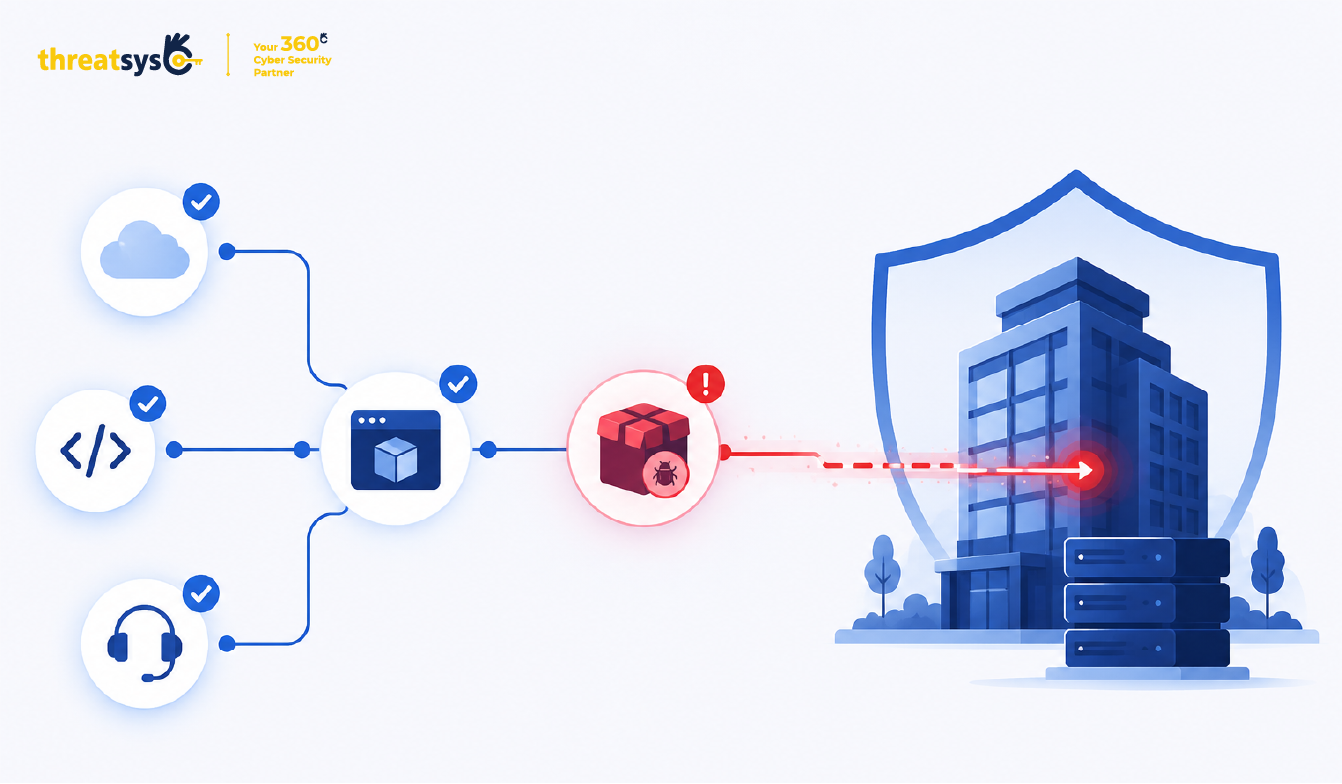
A supply chain attack happens when an attacker compromises something you trust a vendor, a software library, a build tool, a managed service and uses that trust to get access to you.
You didn’t download malware. You didn’t click a phishing link. You installed a legitimate software update from a vendor you’ve used for years. Or a developer on your team pulled a popular open-source package that had been quietly poisoned three weeks earlier.
That’s the insidious part: the attack vector is trust itself. Your defenses are designed to block untrusted things. Supply chain attacks dress themselves as trusted things.
Real Supply Chain Incidents In 2026
OpenAI Plugin Ecosystem Attack
Attackers compromised a widely used plugin in the OpenAI ecosystem, affecting 47 enterprise deployments before the vector was identified. The plugin had passed initial security reviews but a dependency it relied on had been silently modified. Organizations that had integrated the plugin without ongoing monitoring had no visibility into the compromise until lateral movement was detected.
ADT Breach via Okta SSO
ADT’s breach came not through their own systems but through their identity provider. Attackers who gained access to Okta’s environment inherited trusted access to every customer using Okta SSO including ADT. One compromised service provider, cascading impact across thousands of organizations. This is the MSP/services supply chain attack in its cleanest form.
454,000+ Malicious npm and PyPI Packages
In 2026, the volume of malicious packages detected in npm and PyPI registries crossed 454,000 typosquatting legitimate libraries, injecting credential stealers, and in some cases lying dormant for months before executing. Every development team pulling open-source dependencies without verification is running this risk on every build.
Why India Is Especially Exposed
India’s IT sector is built on outsourcing and that creates a supply chain risk profile unlike almost any other country’s enterprise landscape.
Indian MSPs and IT service providers manage hundreds of client environments simultaneously. A single compromised MSP credential doesn’t give an attacker access to one company , it gives them access to an entire portfolio of clients, often across banking, healthcare, manufacturing, and government sectors at once.
Add to this:
- Heavy reliance on open-source frameworks with limited dependency auditing
- Rapid software development cycles that deprioritize third-party code review
- Large vendor ecosystems with inconsistent security standards across tiers
- Limited SBOM adoption that most Indian enterprises don’t know what’s in their software
- MSPs often have privileged access without contractual security obligations
A SolarWinds-type attack India , targeting a single widely-used MSP or software vendor would have a multiplied impact here that most organizations aren’t currently prepared to contain.
Three Types of Supply Chain Attacks
Not all supply chain attacks look the same. Understanding the three main vectors helps organizations build the right controls for each.
| Type | Entry Point | Example | Blast Radius |
| Software | Malicious packages / updates | SolarWinds, npm typosquatting | All users of infected software |
| Hardware | Tampered components / firmware | Compromised network chips | Physical infrastructure |
| Services | MSP or cloud provider breach | ADT via Okta SSO | All clients of that MSP |
Each type requires a different defensive response, but all three share a common requirement: you need visibility into what you’re trusting before you can protect yourself from it being compromised.
The SBOM Revolution : Know What’s Actually in Your Software
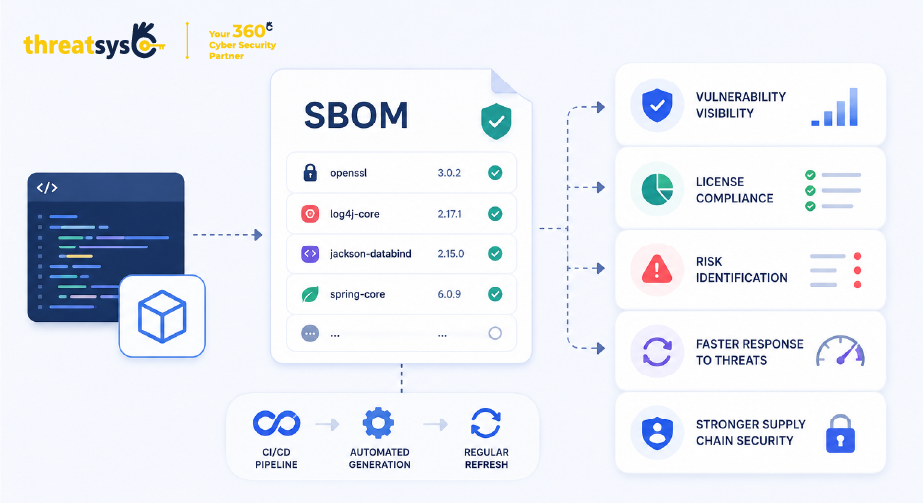
A Software Bill of Materials (SBOM) is exactly what it sounds like: a complete ingredient list for your software. Every library, every dependency, every open-source component versioned, sourced, and documented.
Without an SBOM, when a critical vulnerability is discovered in a widely-used library, your security team has to manually hunt through every application to find out if you’re affected. With an SBOM, you query it and know in minutes.
SBOM India adoption is still early-stage , but it’s accelerating. US federal agencies are now required to demand SBOMs from software vendors. The EU is moving in the same direction under the Cyber Resilience Act. Indian enterprises serving global clients will face the same pressure shortly.
What a good SBOM practice covers:
- All direct and transitive dependencies with version numbers
- License information for compliance and legal risk
- Known vulnerability tracking (CVE mapping)
- Regular refresh cycles that an SBOM is only useful if it stays current
- Integration with CI/CD pipelines for automated generation
An SBOM doesn’t prevent supply chain attacks. It gives you the visibility to detect and respond to them before they become full incidents.
Vendor Risk Assessment : Building a Framework That Actually Works
Most vendor risk programs fail because they treat all vendors equally sending the same 200-question security questionnaire to the company hosting your website and the vendor with direct access to your production database.
Effective third-party vendor risk 2026 management starts with tiering:
Tier 1 — Critical Vendors
Direct access to production systems, customer data, or financial infrastructure. Annual on-site or remote technical audits. Contractual right to audit. Mandatory incident notification SLAs. SOC 2 Type II or equivalent required.
Tier 2 — Significant Vendors
Access to internal systems but not production data. Annual questionnaire with evidence requirements. Security review before contract renewal. Breach notification obligations in contract.
Tier 3 — Standard Vendors
Limited or no system access. Baseline security questionnaire. Annual review. Standard contractual security clauses.
Contractual clauses that every Tier 1 and Tier 2 vendor agreement should include:
- Right to audit security posture annually
- Mandatory breach notification within 24–72 hours
- Data handling and encryption standards
- Subprocessor disclosure obligations
- Incident response cooperation requirements
Threatsys supports enterprises in building vendor risk frameworks and conducting third-party security audits through Infrastructure Security Assessments that evaluate vendor access architecture and identify gaps before they become incidents.
CI/CD Pipeline Security : Where Supply Chain Attacks Are Born
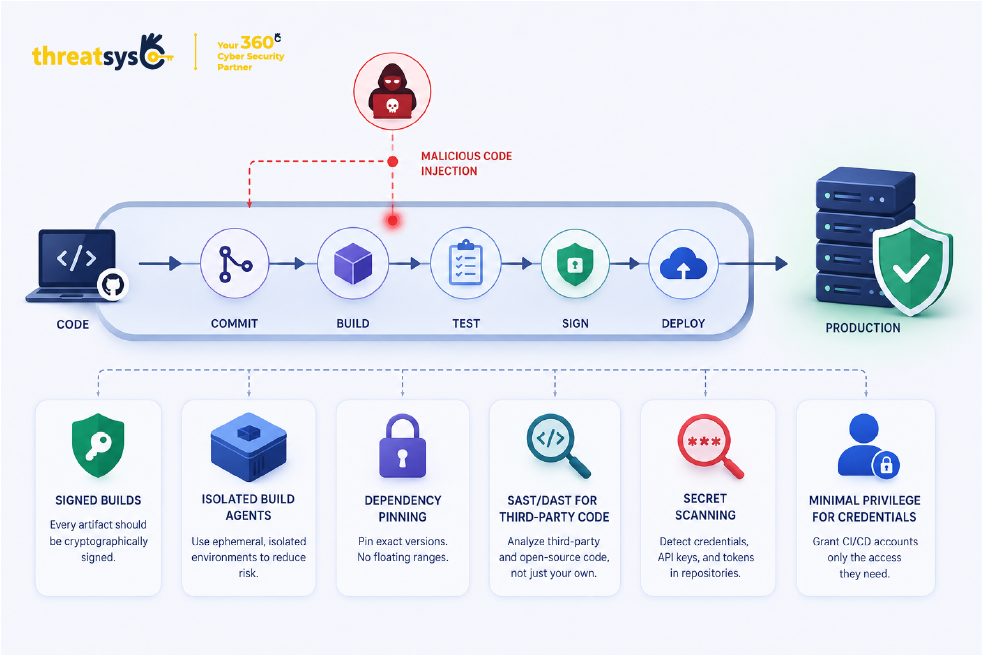
The build pipeline is one of the most under protected parts of the modern enterprise attack surface. If an attacker can inject malicious code into your CI/CD pipeline, they don’t need to breach your production systems , they’ll ship the breach themselves, wrapped in a legitimate build.
Key controls for pipeline security:
- Signed builds — Every artifact should be cryptographically signed. Unsigned artifacts should not reach production.
- Isolated build agents — Build environments should be ephemeral and isolated. Persistent build agents accumulate risk over time.
- Dependency pinning — Pin exact versions, not floating ranges. A dependency that updates automatically is a dependency you don’t fully control.
- SAST/DAST for third-party code — Static and dynamic analysis should cover third-party contributions, not just your own code.
- Secret scanning — Automated detection of credentials, API keys, or tokens accidentally committed to repositories.
- Minimal privilege for pipeline credentials — CI/CD service accounts should have exactly the access they need no more.
Threatsys’s Secure Source Code Review evaluates third-party contributions, dependency integrity, and pipeline configurations , identifying injection points before attackers do.
Regulatory Obligations: What Indian Enterprises Must Know
DPDP Act — Third-Party Processor Obligations
India’s Digital Personal Data Protection Act places explicit obligations on data fiduciaries to ensure their data processors including vendors and MSPs handling personal data that meet security standards. A breach through a vendor does not absolve the data fiduciary of responsibility. DPDP compliance requires contractual security obligations on every third party processing personal data.
RBI Vendor Risk Management
RBI’s cybersecurity framework for banks and financial institutions includes specific guidance on third-party risk management. Financial institutions are required to conduct due diligence on vendors with access to banking systems, maintain an inventory of critical service providers, and ensure contractual security obligations are in place.
NIS2 — Supply Chain Clause
For Indian enterprises operating in or serving European markets, NIS2 includes explicit supply chain security requirements. Organizations must assess the security practices of their direct suppliers and ensure those suppliers have appropriate controls in place. NIS2 compliance is becoming a commercial requirement for Indian IT exporters serving EU clients.
Threatsys’s VCISO Advisory helps enterprises align vendor risk programmes with DPDP Act, RBI, and NIS2 requirements , building governance frameworks that satisfy regulators and protect the business.
How to Detect a Supply Chain Compromise
Supply chain attacks are designed to be invisible arriving through trusted channels, using legitimate credentials. But they leave traces. Knowing what to look for is the difference between catching a compromise early and discovering it during an incident response.
Key detection signals:
- Unusual lateral movement — A vendor integration or service account accessing systems it has never touched before.
- Unexpected outbound connections — Software or services initiating connections to external IPs not in their normal behaviour profile.
- Privilege escalation from vendor accounts — A third-party account suddenly attempting to access elevated permissions.
- Anomalous build artifacts — Binaries or packages with unexpected file sizes, signatures, or behaviour compared to previous versions.
- Off-hours access from integrated services — Vendor integrations authenticating at unusual times with no corresponding business activity.
- New persistence mechanisms — Scheduled tasks, services, or registry modifications created by processes associated with vendor software.
None of these signals individually confirms a compromise. But any of them warrants immediate investigation and a monitoring architecture that can surface them in real time is non-negotiable for supply chain risk management.
How Threatsys Helps Secure Your Supply Chain

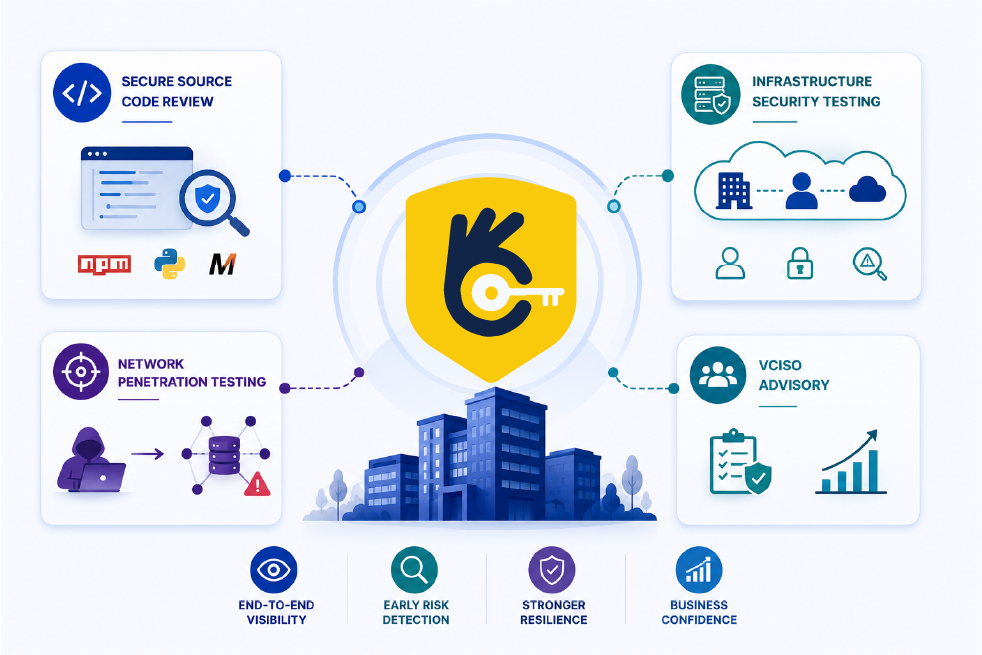
Supply chain security requires visibility across your own code, your vendors’ access, and the dependencies that run silently in everything you ship. Threatsys works with Indian enterprises to build that visibility and close the gaps before attackers find them.
Secure Source Code Review
Threatsys’s Secure Source Code Review examines third-party dependencies, open-source components, and CI/CD pipeline configurations for malicious injections, vulnerable libraries, hardcoded credentials, and insecure build practices. For development teams pulling packages from npm, PyPI, or Maven, this is the control that catches what automated scanners miss.
Infrastructure Security Testing
Threatsys’s Infrastructure Security Assessment evaluates how vendor integrations, MSP access, and third-party connections interact with your internal environment identifying over-privileged vendor accounts, unsegmented access paths, and detection gaps that a supply chain attacker would exploit.
Network Penetration Testing
Threatsys’s Network Penetration Testing simulates supply chain attack scenarios testing whether a compromised vendor credential or malicious software update could move laterally through your environment, escalate privileges, or exfiltrate data without triggering detection.
VCISO Advisory
Building a vendor risk programme, SBOM practice, and pipeline security framework requires strategic ownership not just technical execution. Threatsys’s VCISO Advisory provides that leadership, aligning supply chain security initiatives with DPDP Act, RBI, and NIS2 requirements.
From source code review to vendor risk frameworks to infrastructure testing , Threatsys covers the full supply chain security lifecycle, built around how your environment actually operates.
Conclusion
The next breach hitting a major Indian enterprise will not come through a phishing email or an unpatched server. It will come through a trusted vendor, a popular open-source library, or an MSP with privileged access to hundreds of client environments.
Supply chain attacks are already the preferred vector for sophisticated threat actors because they scale. Compromising one target gives access to hundreds. And most organizations are not structured to detect that kind of attack, let alone prevent it.
Software supply chain security India 2026 is not a future concern. The incidents are happening now. The organizations that build visibility and controls today will be the ones that catch a compromise early. The ones that wait will find out the hard way.
“Your next breach won’t come through your front door. Build security for the door you’re not watching.”
Stay secure, stay aware with Threatsys.