

Your VPN and Firewall Are Now Useless ,Here’s the Only Security Framework That Works in 2026
A complete guide to Zero Trust Architecture India 2026 for enterprises that can’t afford to get this wrong.
What Is Zero Trust Architecture?
Old security was built like a castle. Thick walls outside, free movement inside. Get past the moat, and you were trusted by default. VPNs and firewalls were that moat.
In 2026, there will be no moat. Your data lives across AWS, Azure, and on-prem. Your team logs in from Bengaluru, Bhopal, and a hotel in Dubai. The castle walls don’t exist anymore and attackers figured that out long before most security teams did.
Zero Trust Architecture (ZTA) flips the model completely. The principle is simple: never trust, always verify. No user, device, or connection gets automatic access not even from inside your own office network. Every single request is evaluated in real time before access is granted. And it keeps being evaluated throughout the session.
Zero Trust is not a product you buy. It is a security strategy you build one layer at a time.

Why Indian Enterprises Need Zero Trust Right Now
India is not a small market anymore and neither is its attack surface.
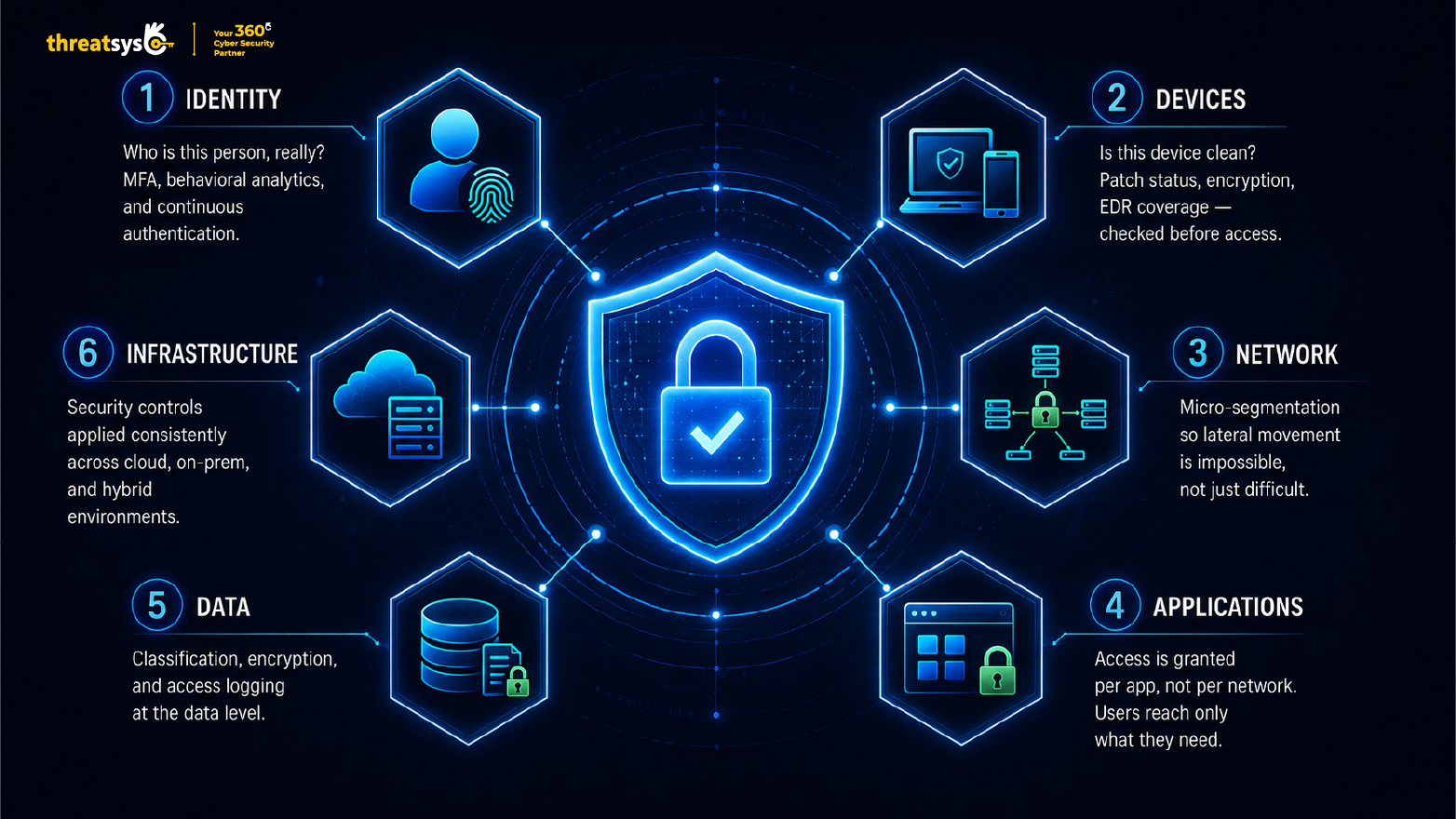
82% of Indian enterprises now operate in hybrid or multi-cloud environments. Remote work is permanent for a large share of the workforce. BYOD policies mean corporate data flows through personal devices on home networks. And UPI now processes over 13 billion transactions a month each one a potential target.
The threats have followed the growth. Identity-based attacks, compromised third-party vendor credentials, and cloud misconfigurations are now the primary attack vectors in India’s enterprise landscape.
A VPN gives an attacker who steals one set of credentials access to everything. Zero trust network access India 2026 , implemented properly , limits that damage to exactly one application.
This is not a future problem. It is a present one.
The 6 Pillars of Zero Trust
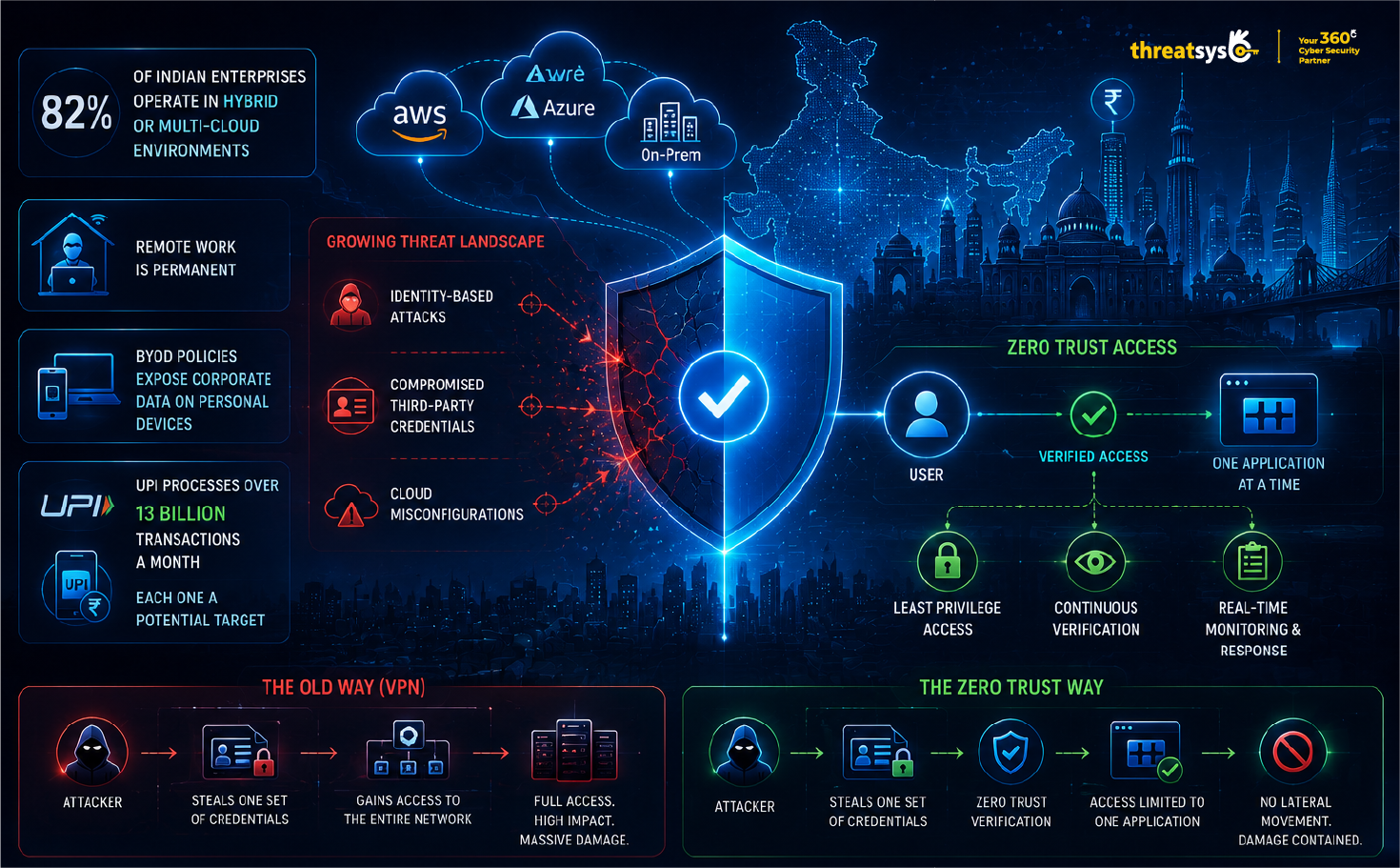
Zero Trust is not one tool — it is six interlocking security layers working together:
- Identity — Who is this person, really? MFA, behavioral analytics, and continuous authentication.
- Devices — Is this device clean? Patch status, encryption, EDR coverage , checked before access.
- Network — Micro-segmentation so lateral movement is impossible, not just difficult.
- Applications — Access is granted per app, not per network. Users reach only what they need.
- Data — Classification, encryption, and access logging at the data level.
- Infrastructure — Security controls applied consistently across cloud, on-prem, and hybrid environments.
Miss any one of these and the architecture has a gap. Zero Trust only works when all six are addressed.
How Zero Trust Works in Practice
Here’s what happens every time a user requests access under a Zero Trust model:
- Step 1 — Identity check: MFA, SSO, or certificate-based auth confirms who they are.
- Step 2 — Device check: Is the device compliant? Updated OS? Encryption enabled? No unauthorized apps?
- Step 3 — Context analysis: Location, time of day, and behavioral patterns are factored in.
- Step 4 — Risk score: A dynamic score is calculated. High risk = denied or step-up auth required.
- Step 5 — Continuous monitoring: The session is watched. Anomalous behavior mid-session triggers immediate re-verification or revocation.
This is the ZTNA implementation framework in action , access that is contextual, conditional, and never permanent.
Zero Trust vs VPN vs SASE
The zero trust vs VPN 2026 debate is not really a debate anymore. Here is what the numbers and architecture say:
| Feature | VPN / Firewall | Zero Trust (ZTNA) |
| Access scope | Full network access | App-by-app only |
| Trust model | Trust once, done | Verify every request |
| Lateral movement | Unrestricted | Blocked by design |
| Remote work fit | Poor | Built for it |
| Breach blast radius | Massive | Contained |
SASE (Secure Access Service Edge) takes this further, merging network and security into one cloud-native platform. Think of it as Zero Trust plus SD-WAN, delivered as a service. For large enterprises with multiple sites and cloud workloads, SASE is the logical end-state.
Not sure where your organization sits on this spectrum? Threatsys begins every engagement with a Zero Trust Readiness Assessment mapping your current VPN dependencies, cloud exposure, and access architecture to identify exactly which model fits your environment. From there, our Infrastructure Security and Network Pen Testing teams help you close the gaps before you transition , so the move from VPN to ZTNA or SASE is clean, not chaotic.
Industry Use Cases in India
Banking & Financial Services (RBI Compliance)
RBI’s cybersecurity guidelines increasingly point toward continuous authentication and least privilege access ,exactly what Zero Trust delivers. Banks securing digital transaction systems, payment gateways, and internal portals are using ZTNA to prevent credential-based fraud and meet compliance requirements without slowing operations.
Threatsys supports BFSI teams through Network Penetration Testing and Infrastructure Security Assessments , helping banks identify exploitable gaps in their access architecture before RBI audits or attackers do.
Government Portals (CERT-In)
CERT-In’s 2022 directive on incident reporting pushed government agencies to rethink their access architectures. Zero Trust enables them to secure citizen data, restrict internal access based on role, and detect anomalies before they become incidents.
Threatsys works with government and public sector teams through VCISO Advisory Services to align Zero Trust rollouts with CERT-In directives , building governance frameworks that satisfy compliance requirements and hold up under real-world scrutiny.
Healthcare (DPDP Act)
India’s Digital Personal Data Protection Act puts serious obligations on healthcare organizations. Patient records, diagnostic data, and clinical systems need access controls that go beyond a login screen. Zero Trust gives healthcare providers the granular control the DPDP Act demands.
Threatsys conducts Infrastructure Security Assessments tailored to healthcare environments , mapping data access flows, identifying over-privileged accounts, and implementing controls that put healthcare organizations in a defensible position under the DPDP Act.
IT & SaaS Companies
Distributed teams, contractor access, and multi-cloud infrastructure make IT and SaaS companies a natural fit for Zero Trust. ZTNA replaces the clunky, slow VPN experience with application-level access that works from anywhere and doesn’t expose the whole network if one account is compromised.
Threatsys helps IT and SaaS teams design and validate their Zero Trust rollout from Network Penetration Testing that stress-tests access controls, to VCISO-led strategy that keeps security aligned with the pace of product and team growth.
Zero Trust Implementation Roadmap
Phase 1: Identity-First (Days 1–30)
- Deploy MFA across all users no exceptions
- Implement role-based access control tied to job function
- Centralize identity management under a single IAM platform
Phase 2: Device Trust (Days 30–60)
- Enforce endpoint compliance checks before access is granted
- Real-time device posture validation, patch level, encryption, AV
- Block access from non-compliant devices automatically
Phase 3: Micro segmentation (Days 60–90)
- Segment the network at the application level
- Apply least privilege users access only what their role requires
- Prevent lateral movement: if one system is hit, the rest stay clean
This phased approach lets you build Zero Trust without disrupting the business. Security improves with each phase, and the architecture gets stronger over 90 days.
Common Mistakes in Zero Trust Adoption
- Buying a product and calling it Zero Trust. No single vendor delivers Zero Trust. It’s a framework. Tools support it , they don’t replace it.
- Skipping device posture checks. A verified identity on an unpatched device is still a risk. Both checks are non-negotiable.
- Ignoring third-party vendors. Supply chain attacks start through vendor access. Every third party with system access needs to be inside the Zero Trust perimeter.
- Keeping VPNs running in parallel. Hybrid VPN + ZTNA setups create conflicting access policies and a false sense of security. VPN should be phased out, not maintained alongside.
Cost vs. ROI — The Financial Case
The average cost of a data breach in the US hit $10.22 million in 2024. In India, costs are lower but rising sharply and reputational damage does not respect geography.
Zero Trust delivers measurable financial returns:
- Preventing a single major breach typically covers the full cost of implementation
- 30–50% reduction in VPN infrastructure and licensing costs
- Faster detection and containment reduces breach recovery time significantly
- Audit readiness and compliance posture improve — reducing regulatory risk
How Threatsys Helps You Get This Right

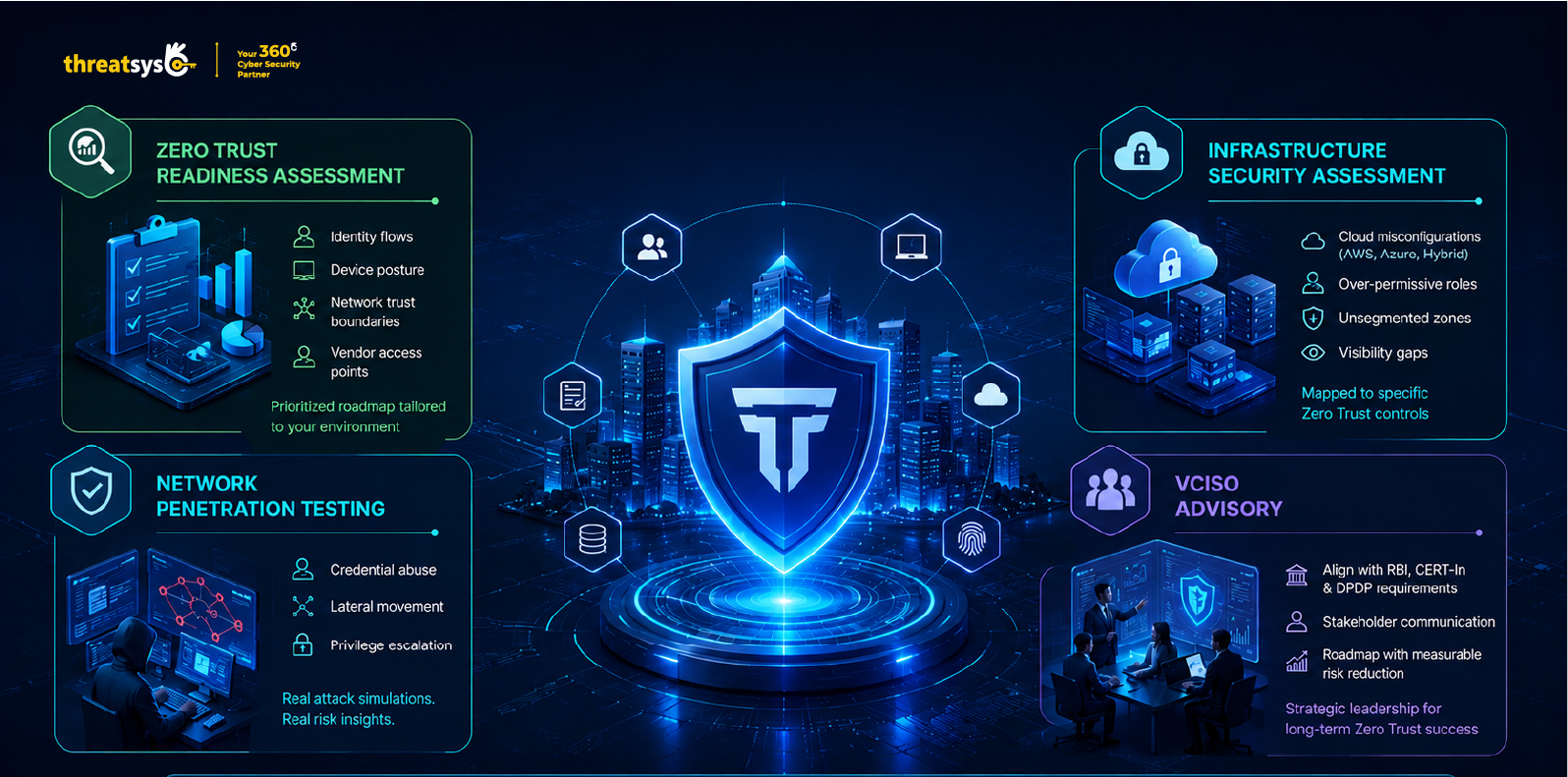
Most Zero Trust projects stall in the middle, tools get purchased, but nobody mapped the legacy dependencies, the third-party access, or the gaps that already exist. Threatsys works with Indian enterprises to build Zero Trust architectures grounded in how your environment actually works.
Zero Trust Readiness Assessment
Every engagement starts with an honest gap analysis , identity flows, device posture, network trust boundaries, and vendor access points. The output is a prioritized roadmap specific to your environment, not a generic framework.
Network Penetration Testing
Before redesigning access controls, you need to know what an attacker can already reach. Threatsys’s Network Pen Testing simulates real attack scenarios credential abuse, lateral movement, privilege escalation , so your Zero Trust segmentation strategy is built around actual risk, not assumed risk.
Infrastructure Security Assessment
Cloud misconfigurations are now the leading cause of enterprise breaches in India. Threatsys’s Infrastructure Security Assessment covers your full environment, AWS, Azure, on-prem, and hybrid, identifying over-permissive roles, unsegmented zones, and visibility gaps, each mapped to a specific Zero Trust control.
VCISO Advisory
Zero Trust is a multi-year transformation , it needs strategic ownership, not just technical execution. Threatsys’s VCISO Advisory provides that leadership: aligning the roadmap with RBI, CERT-In, and DPDP requirements, managing stakeholder communication, and keeping every phase tied to measurable risk reduction.
With the right strategy, processes, and security controls in place, Zero Trust becomes more than a cybersecurity framework, it becomes a foundation for long-term resilience and secure digital growth.
Conclusion
Zero trust architecture India 2026 is not a trend. It is a response to how enterprise infrastructure actually works today , distributed, cloud-native, remote, and constantly targeted. The perimeter is gone. The castle moat is gone. What remains is identity, context, and continuous verification.
Organizations still betting on VPNs and perimeter firewalls are one stolen credential away from a serious incident. The ones building Zero Trust architectures now are making it structurally much harder for that credential to matter.
“Never trust, always verify” is not just a security principle. In 2026, it is the only architecture that makes sense.
Stay secure, stay aware with Threatsys.