

In today’s hyperconnected world, critical infrastructure systems are becoming increasingly dependent on digital technologies and industrial automation. From power plants and oil refineries to water treatment facilities and manufacturing industries, organizations rely heavily on SCADA systems to monitor and control essential operations.
However, as industrial environments become more connected, they also become more vulnerable to cyberattacks.
Modern cybercriminals are no longer targeting only corporate IT systems, they are actively attacking operational technology (OT) environments and critical infrastructure systems capable of causing large-scale disruption, financial loss, and even public safety risks.
This is where SCADA and critical infrastructure cybersecurity becomes essential.
At Threatsys, we help organizations strengthen industrial cybersecurity through advanced security assessments, threat detection, incident response, and proactive protection strategies designed specifically for modern OT and industrial environments.
What is SCADA & Critical Infrastructure Security?
SCADA (Supervisory Control and Data Acquisition) systems are industrial control systems used to monitor, manage, and automate critical infrastructure operations.
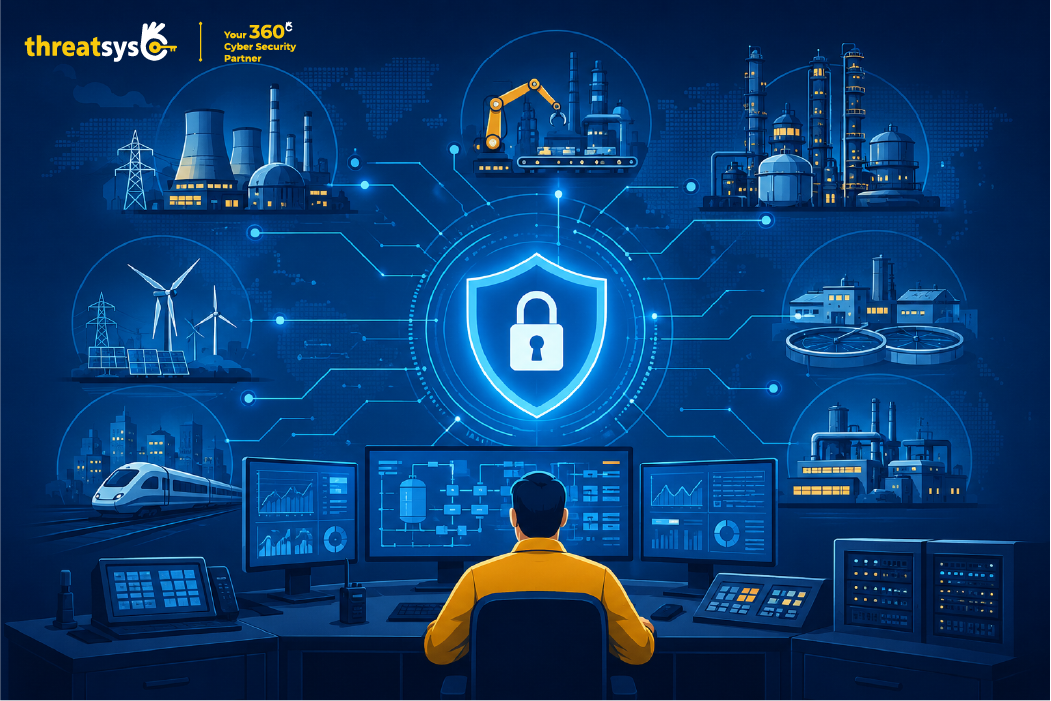
- Energy and power generation industries that manage electricity production, transmission, and distribution systems.
- Oil and gas sectors that rely on industrial automation for refining, pipeline monitoring, and operational control.
- Manufacturing environments that use automated production systems and industrial control technologies.
- Transportation networks including railways, airports, ports, and smart traffic management systems.
- Water treatment and utility facilities responsible for water purification, supply, and waste management operations.
- Smart city infrastructure that integrates connected technologies for urban management and public services.
- Telecommunications sectors that depend on secure and uninterrupted communication infrastructure.
- Healthcare infrastructure including hospitals, medical devices, and critical patient care systems.
Critical infrastructure security focuses on protecting these industrial systems, operational technologies, networks, and connected devices from cyber threats, unauthorized access, operational disruptions, and data compromise.
Unlike traditional IT environments, SCADA systems directly control physical operations. A successful cyberattack on industrial infrastructure can impact not only digital systems but also real-world operations, public safety, and national security.
Why Critical Infrastructure Security Matters More Than Ever
Industrial environments are rapidly adopting cloud connectivity, IoT devices, remote access systems, and smart automation technologies. While these advancements improve operational efficiency, they also increase the attack surface for cybercriminals.
Modern attackers target critical infrastructure because disruptions in these sectors can create massive operational and economic consequences.
Without proper cybersecurity controls, organizations may struggle to identify:
- How attackers gained access to industrial control systems and OT environments.
- Which SCADA devices, PLCs, or industrial networks were compromised during an attack.
- Whether operational processes were manipulated or disrupted by unauthorized actors.
- How attackers maintained persistence within industrial environments without detection.
- Which security gaps still exist across legacy systems and connected infrastructure.
SCADA cybersecurity provides the visibility and protection needed to secure industrial operations while reducing business and operational risks.
The Rising Cyber Threats Against SCADA Systems
Cyberattacks against industrial environments are becoming more sophisticated every year.
Organizations now face threats such as:
- Ransomware attacks targeting industrial operations and production environments.
- Insider threats involving unauthorized access to critical systems and industrial networks.
- Supply chain attacks targeting third-party vendors and connected industrial platforms.
- Remote access exploitation through insecure VPNs, weak credentials, and exposed services.
- Malware designed specifically for industrial control systems and operational technology.
- Nation-state attacks targeting critical infrastructure sectors such as energy, utilities, and transportation.
As digital transformation accelerates, industrial organizations must adopt stronger cybersecurity strategies to defend against evolving threats.
How Modern SCADA Security is Evolving
Traditional industrial environments were designed primarily for operational efficiency, not cybersecurity. Many legacy systems still lack modern security protections, making them vulnerable to advanced cyber threats.
To address these challenges, SCADA security is evolving with:
- AI-driven threat detection that identifies abnormal industrial behavior and suspicious operational activities in real time.
- Continuous network monitoring that helps detect unauthorized communication within OT environments.
- Behavioral analytics that identifies unusual user actions and potential insider threats across industrial systems.
- Threat intelligence integration that enables organizations to detect known attacker tactics and malicious indicators proactively.
- Segmentation and zero-trust architectures that isolate critical systems and reduce attack propagation risks.
- Automated incident response capabilities that improve containment and recovery during cyber incidents.
These technologies help organizations strengthen operational resilience while minimizing disruption risks.
Challenges Businesses Face in Industrial Cybersecurity
Securing SCADA and critical infrastructure environments remains highly complex.
Organizations often struggle with:
- Legacy industrial systems that were never designed with cybersecurity in mind.
- Limited visibility across distributed OT and industrial environments.
- Downtime concerns that make security updates and patch management difficult.
- Convergence between IT and OT systems that increases overall attack exposure.
- Lack of skilled cybersecurity professionals specializing in industrial and OT security.
- Increasing compliance and regulatory requirements for critical infrastructure protection.
Without a proactive security strategy, these challenges can significantly increase cyber risk exposure.
How Threatsys Helps Secure SCADA & Critical Infrastructure

Modern industrial cybersecurity requires more than traditional IT security tools. Organizations need specialized OT security expertise capable of protecting both digital and physical operations.
At Threatsys, we help organizations strengthen industrial cybersecurity through advanced SCADA and critical infrastructure protection services tailored for modern operational environments.
Our cybersecurity experts help businesses:
- Conduct SCADA security assessments, OT penetration testing, and industrial vulnerability analysis.
- Identify hidden security gaps, insecure protocols, and exposed industrial assets before attackers exploit them.
- Secure industrial control systems, PLCs, RTUs, HMIs, and connected operational technologies.
- Build stronger incident response strategies for industrial cyber incidents and operational disruptions.
- Implement continuous monitoring, threat intelligence, and proactive threat detection across OT environments.
- Strengthen compliance readiness for industrial security frameworks and regulatory standards.
- Secure hybrid infrastructure, cloud-connected industrial systems, and remote operational environments.
With a proactive and intelligence-driven approach, Threatsys helps organizations improve cyber resilience while protecting critical operations from modern cyber threats.
The Role of AI in Industrial Cybersecurity
Artificial Intelligence is transforming industrial cybersecurity by enabling faster threat detection and smarter operational protection.
AI-powered systems can analyze industrial network traffic, operational logs, and behavioral patterns far faster than traditional manual analysis methods.
Instead of relying only on signature-based detection, AI helps organizations identify hidden attack behaviors, unauthorized system activities, and operational anomalies in real time.
This enables security teams to move from reactive defense toward predictive cybersecurity strategies that minimize operational disruptions and improve resilience.
The Future of SCADA & Critical Infrastructure Security
The future of industrial cybersecurity will be shaped by intelligent automation, AI-driven monitoring, and proactive threat prevention.
As industrial systems continue to evolve, organizations will increasingly rely on:
- AI-powered threat intelligence for detecting emerging industrial cyber threats.
- Automated security monitoring for real-time OT environment visibility.
- Cloud-native industrial security capabilities for hybrid operational environments.
- Zero-trust architectures for protecting connected infrastructure and remote operations.
- Predictive cybersecurity models that help prevent operational disruptions before attacks occur.
Organizations that invest in industrial cybersecurity today will be far better prepared for tomorrow’s cyber threats.
Conclusion
SCADA and critical infrastructure security has become a critical pillar of modern cybersecurity. As industrial systems become more connected and automated, cyber threats targeting operational environments continue to grow in scale and sophistication. Businesses must go beyond traditional security approaches and adopt proactive strategies capable of protecting industrial operations, operational technology, and critical infrastructure from evolving cyber risks.
A strong SCADA cybersecurity strategy helps organizations improve operational resilience, reduce cyber risks, maintain business continuity, and protect essential services from disruption.
At Threatsys, we help businesses strengthen their industrial cybersecurity posture through advanced SCADA security assessments, intelligent threat detection, and proactive incident response solutions designed for modern critical infrastructure environments.
Because in today’s connected industrial world, securing critical infrastructure is no longer optional, it is essential.
Stay secure, stay aware with Threatsys.