

Indian Banks Have Spent a Decade Treating Cybersecurity as a Policy Document. RBI Just Told Them That Era Is Over.
A complete breakdown of RBI’s 2024 to 2026 cybersecurity overhaul for banks, NBFCs and Small Finance Banks, what changed, who it hits hardest, and what Threatsys sees coming next.

You have a board approved IT policy. You have a CISO. You file your compliance reports on time. And you still do not actually know whether your bank could survive a real incident, or whether your vendor’s security posture is anything more than a signed questionnaire sitting in a compliance folder.
That is the exact gap RBI has spent the last three years closing. Between the 2024 Master Directions on IT Governance, the 2025 Authentication Mechanisms for Digital Payment Transactions Directions, and the 2026 Cybersecurity, Technology and Risk Resilience Directions for Small Finance Banks, India’s banking regulator has quietly rebuilt the entire compliance architecture the sector operates under.
This is not a routine circular update. This is RBI telling banks, NBFCs and payment companies that documentation is no longer proof of security. Evidence is.
What Actually Changed
Four shifts define this new phase of regulation.
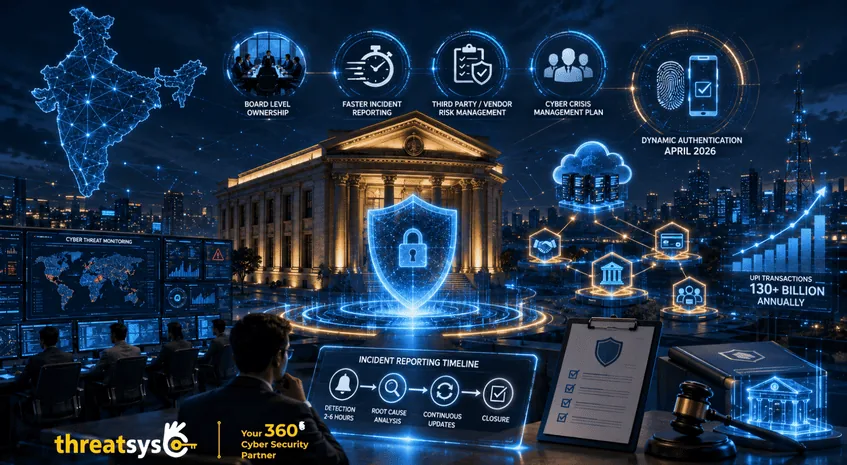
Board level ownership, not IT department ownership. A dedicated IT Strategy Committee at board level is now required, and the IT risk framework itself must carry board approval, not senior management sign off.
Faster and more accountable incident reporting. Banks must still flag unusual cyber incidents to RBI’s CSITE cell within two to six hours of detection. What has changed is the expectation that follows: root cause analysis and continuous updates until the incident is fully closed, not a single report that goes silent.
Third party and vendor risk is no longer a checkbox. Annual vendor questionnaires are explicitly called out as insufficient. Banks must now produce independent evidence that critical vendors, cloud providers, core banking software and KYC or AML platforms have actually been assessed. The 2026 Small Finance Bank Directions push this further with tighter exit clauses and concentration risk monitoring.
A Cyber Crisis Management Plan is now mandatory for everyone. What used to be a large bank requirement is now baseline for Small Finance Banks, cooperative banks and NBFCs too.
On top of all this sits RBI’s 2025 authentication mandate: a dynamic authentication factor for digital transactions from April 2026, closing the door on OTP only flows that phishing and SIM swap fraud have exploited for years.
Real 2026 Data Point
RBI’s own supervisory commentary has flagged AI enabled cyberattacks as one of the most significant emerging risks facing India’s financial sector. Meanwhile UPI transaction volumes continue climbing past 130 billion annually, and digital lending platforms are multiplying faster than most compliance teams can audit them.
No single breach triggered this round of regulation. What triggered it was volume: more digital transactions, more vendors, more attack surface, arriving faster than the old 2016 framework was ever built to supervise.
That is the pattern worth understanding. RBI is not reacting to one incident. It is compressing years of expected regulatory evolution into a much shorter runway, because the threat landscape stopped waiting for the usual audit cycle.
Who This Actually Hits, and How

For bank customers
Most of this stays invisible until the payment screen. Dynamic authentication means an OTP alone will stop being enough for many digital transactions, so expect an extra verification step: a PIN, a biometric check or a device bound factor. Pre debit alerts for recurring payments like subscriptions, EMIs and insurance premiums are also becoming mandatory, giving customers a window to cancel or dispute a charge before it is deducted. Fewer successful phishing and SIM swap frauds is the upside. A slightly slower checkout during the transition is the tradeoff.
For the banking sector
This is where the real weight lands. Boards can no longer delegate cybersecurity to IT and forget it. It is now a personal governance responsibility with direct audit exposure. Compliance costs rise fastest for mid sized and small institutions, who must now match large bank standards on vendor audits and crisis planning without large bank budgets. Institutions that get ahead of this differentiate on trust. Institutions that treat it as paperwork will be the first ones RBI’s supervisory exams flag.
For businesses, fintechs and vendors
Any company supplying technology, payment infrastructure or data services to a bank is now indirectly regulated. Holding an ISO certificate is no longer a sufficient answer to a bank’s vendor risk questionnaire. Banks need independent proof, and that pushes fintechs and vendors toward more frequent third party audits and tighter contractual accountability. Vendors who build compliance readiness into their product now will win bank contracts faster than the ones scrambling to catch up after the fact.
Where Compliance Costs Actually Come From
|
Cost Driver |
Root Cause |
Impact on Regulated Entities |
|
Board Governance Gap |
Policy approved without real understanding |
Audit exposure when regulators probe board accountability |
|
Vendor Risk Evidence |
Self attestation no longer accepted |
Recurring third party audit costs for every critical vendor |
|
CCMP Mandate |
Untested crisis plans treated as compliant |
Tabletop exercises and incident simulation now required |
|
Authentication Migration |
Legacy systems built around static OTP |
Infrastructure rework across core banking and payment gateways |
|
Talent Shortage |
Continuous evidence based assessment needs specialists |
Growing dependency on external audit and MSSP partners |
Benefits Versus Disadvantages
The benefits are real. Customers see reduced fraud exposure, particularly around phishing and SIM swap exploitation. Boards carry genuine accountability instead of symbolic sign off. Smaller banks and NBFCs can no longer under invest in resilience just because they are smaller. Vendor accountability finally closes a blind spot that has been the weakest link in otherwise secure banks for years.
The disadvantages are just as real. Compliance costs rise disproportionately for Small Finance Banks, cooperative banks and smaller NBFCs with thinner budgets. Customers face short term friction as authentication flows change. Mandates on paper do not guarantee tested capability, a rushed CCMP or a superficial vendor audit can create a false sense of security rather than actual resilience. And most regulated entities simply do not have in house teams capable of running continuous, evidence based assessments at the pace RBI now expects, which pushes them toward external partners under time pressure.

The Threatsys Perspective
Regulation tends to lag exploitation, not lead it. Attackers were already targeting vendor supply chains and static OTP flows long before RBI wrote rules against them. What is unusual this time is the speed. The gap between the 2024 IT Governance directions, the 2025 authentication rules and the 2026 Small Finance Bank directions is unusually tight for a regulator historically known for slow, deliberate rule making.
That compressed timeline tells you something important. RBI is responding to a threat landscape evolving faster than its own audit cycle can absorb. AI enabled social engineering, deepfake assisted fraud and increasingly professionalised ransomware targeting mid tier financial institutions are pushing the regulator to legislate proactively, a genuinely rare posture for a central bank.
Our read at Threatsys is simple. This is not about new controls. It is about closing the gap between documented compliance and demonstrable resilience. RBI has told the sector to stop showing policies and start showing evidence. Institutions that treat this as another audit to pass will stay vulnerable to the exact fundamentals it targets. Institutions that treat it as an operating discipline will actually reduce risk.
How Threatsys Helps Regulated Entities Get There

Board and Governance Readiness
We translate the technical IT risk framework into language a board can genuinely own and defend under audit, not just sign off on in a five minute agenda item.
Independent Vendor and Third Party Risk Assessment
We replace the self attestation questionnaire with real, evidence backed audits of critical cloud, core banking and KYC or AML vendors, exactly what RBI now expects to see.
CCMP Design and Tabletop Stress Testing
We build a Cyber Crisis Management Plan that survives contact with a real incident, not just a compliance review, through simulated crisis exercises run against your actual environment.
VAPT and Penetration Testing
Our CERT-IN empanelled testing covers internet facing assets and digital lending or API layers, aligned to RBI’s periodic assessment mandates.
Incident Detection and Response Readiness
We close the gap between must report within six hours and can actually detect within six hours, through managed SOC and detection support built for BFSI environments.
Authentication Migration Support
We help payment and banking platforms move off static OTP flows toward dynamic, phishing resistant authentication ahead of the April 2026 deadline.
For Small Finance Banks and NBFCs specifically, the segment most newly exposed by the 2026 Directions and least resourced to meet it, this is where a partner like Threatsys stops being a nice to have and becomes the fastest, most credible path to genuine compliance.

Conclusion
RBI has not rewritten bank cybersecurity rules so much as it has rewritten the proof standard. Board accountability, verifiable third party risk management, mandatory crisis planning regardless of institution size and dynamic authentication all point toward one thing: a regulator that has stopped accepting good intentions as a substitute for tested controls.
For customers, that mostly means safer transactions with a little more friction along the way. For banks and NBFCs, it is an inconvenient but necessary maturity leap. For the cybersecurity ecosystem supporting them, auditors, penetration testers and managed security providers like Threatsys, it is a mandate to get more rigorous, faster.
Your bank did not outgrow its cybersecurity policy. It just got asked, for the first time, to actually prove it.
To stay ahead, businesses must adopt proactive, intelligence-driven security strategies that simulate real-world threats and continuously validate their defenses. With Threatsys , organizations can build a resilient and future-ready security framework—ensuring their systems remain protected in an increasingly connected world.

Stay secure, Stay aware with Threatsys.