

Mobile applications have become the backbone of modern digital ecosystems powering everything from fintech and healthcare to e-commerce and enterprise operations. But as mobile adoption accelerates, so do the threats targeting these applications.
In 2026, attackers are no longer just exploiting basic vulnerabilities — they are leveraging advanced reverse engineering, API abuse, and runtime manipulation techniques to compromise mobile apps at scale.
This is where the OWASP Mobile Application Security Verification Standard (MASVS) becomes critical. With its latest updates, MASVS is no longer just a guideline — it is a comprehensive security benchmark for building, testing, and maintaining secure mobile applications.
Below are the 5 essential MASVS-driven mobile app security requirements organizations must implement to stay secure, compliant, and resilient in 2026.
1. Adopt MASVS-Aligned Security Requirements from Day One
Security cannot be retrofitted. In 2026, mobile app security must begin at the design and development stage, not after deployment.
The OWASP MASVS framework provides structured security controls across critical areas such as secure data storage, authentication, cryptography, and platform interaction. It also introduces clear validation criteria, enabling teams to measure whether security controls are correctly implemented—not just defined.
Organizations must map their applications to appropriate MASVS levels (L1, L2, and Resilience) based on risk and data sensitivity. This risk-based approach ensures that high-value applications (such as fintech or healthcare apps) receive stronger protection controls.
Early alignment with MASVS helps:
- Reduce costly post-deployment fixes
- Eliminate architectural vulnerabilities
- Build a secure foundation from the start
2. Secure Data Across Storage, Transit, and Runtime
Mobile applications handle highly sensitive data, making end-to-end protection essential. Security must extend across storage, transmission, and runtime environments.
MASVS 2026 emphasizes not just encryption, but secure implementation and lifecycle management of data protection controls.
- Strong encryption (AES-256) and secure transmission (TLS 1.2+)
- Robust key management, including hardware-backed keystores where available
- Prevention of data leakage via logs, backups, memory exposure, or screenshots
Additionally, organizations must ensure that sensitive data is never unnecessarily stored, aligning with modern privacy and data minimization principles.
Relying on default configurations is a critical mistake. Every control must be explicitly configured, validated, and continuously monitored to ensure data remains protected even if a breach occurs.
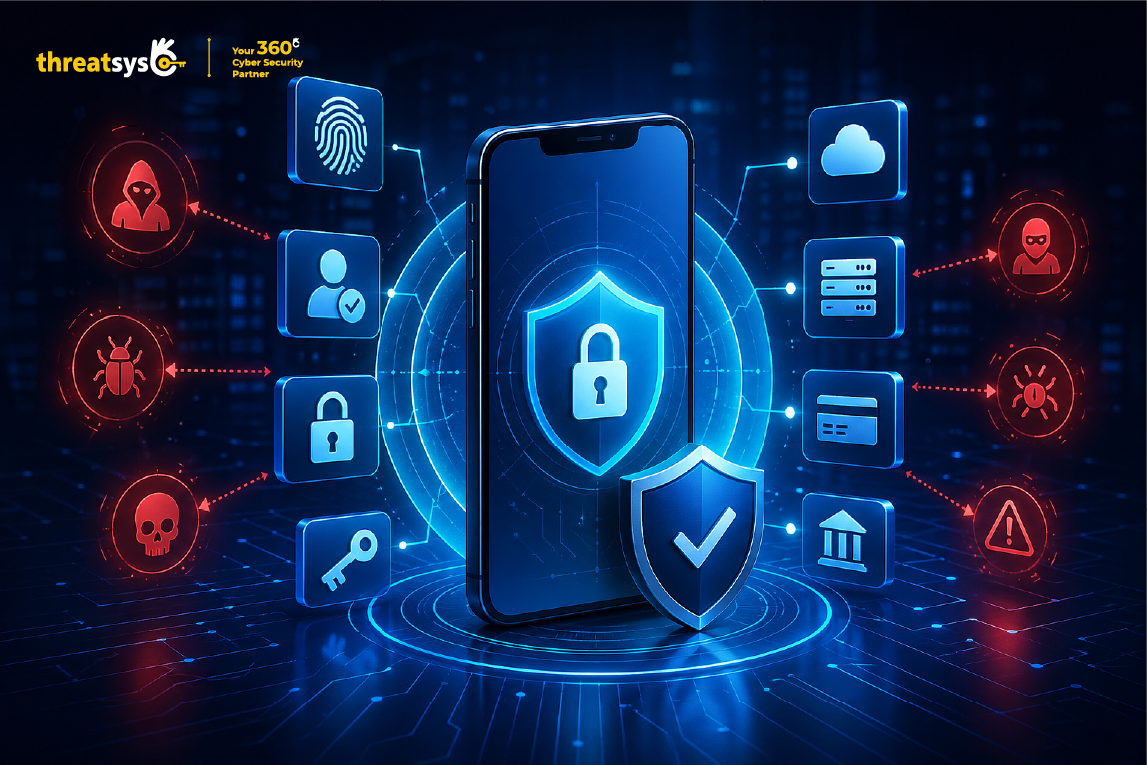
3. Strengthen Identity, Authentication & Authorization Controls
Credential-based attacks remain a leading cause of mobile breaches. Weak authentication flows, insecure session handling, and improper authorization checks significantly increase risk exposure.
MASVS mandates strong identity security through:
- Multi-factor authentication (MFA) and secure session lifecycle management
- Role-based access control (RBAC) with strict least-privilege enforcement
- Continuous monitoring for suspicious authentication patterns
In 2026, identity security is evolving toward adaptive and risk-based authentication, where access decisions consider device health, location, and behavioral patterns.
Modern identity security goes beyond access — it requires continuous validation of user activity, session integrity, and intent.
4. Implement Runtime Protection & Anti-Tampering Controls
Attackers increasingly target applications at runtime using reverse engineering, dynamic instrumentation, and memory manipulation techniques. Traditional static defenses alone are no longer sufficient.
To counter this, MASVS 2026 places strong emphasis on application resilience and runtime protection:
- Root/jailbreak detection and anti-debugging mechanisms
- Code obfuscation, binary protection, and integrity verification
- Runtime Application Self-Protection (RASP) for real-time threat mitigation
These controls ensure the application remains secure even in hostile or compromised environments, such as rooted devices or emulators used by attackers.
Runtime protection is especially critical for apps handling financial transactions, authentication tokens, or proprietary business logic.
5. Move to Continuous Security Testing & MASVS-Based Validation
One-time penetration testing is no longer effective against rapidly evolving threats. Mobile security in 2026 requires continuous validation integrated into the development lifecycle.
Organizations should adopt a layered and automated testing strategy:
- MASVS-aligned penetration testing covering real-world attack scenarios
- Combined SAST, DAST, and IAST for comprehensive coverage
- API security testing to protect backend integrations
- Automated security scans embedded within CI/CD pipelines
Testing must also align with the OWASP Mobile Top 10, ensuring focus on high-impact, real-world vulnerabilities.
How Threatsys Secures Mobile Applications with MASVS

Modern organizations face a critical challenge — delivering seamless mobile experiences while ensuring enterprise-grade security.
Threatsys provides end-to-end mobile app security solutions aligned with MASVS 2026 standards, helping businesses transform security into a competitive advantage.
- MASVS-Based Security Assessment & Gap Analysis – Identifying vulnerabilities across mobile apps and mapping them to MASVS controls with prioritized, actionable remediation strategies.
- Mobile Application Penetration Testing – Simulating advanced real-world attacks, including reverse engineering, API exploitation, and runtime manipulation.
- Secure Code Review & DevSecOps Integration – Embedding security directly into CI/CD pipelines to detect and remediate vulnerabilities early.
- Runtime Protection & App Hardening – Implementing anti-tampering, RASP, and advanced resilience mechanisms to defend against live attacks.
- Continuous Monitoring & Threat Detection – Providing real-time visibility into threats, anomalous behavior, and potential breaches.
Threatsys empowers organizations to build secure, compliant, and future-ready mobile applications without slowing down innovation.
Conclusion
Mobile app security in 2026 is no longer limited to preventing basic vulnerabilities — it is about defending against sophisticated, real-time, and large-scale attacks. The evolution of MASVS provides a clear, structured roadmap for securing applications across design, development, deployment, and runtime environments. Organizations that adopt MASVS-driven security practices will not only reduce risks but also build user trust, regulatory readiness, and long-term resilience.
The cost of insecure mobile applications continues to rise — not just in financial losses, but in brand reputation and customer trust.
Stay secure, stay aware with Threatsys.